reabc/When Love is By Choice instead of Chance - C Anthony Taylor/When Love is By Choice instead of Chance - C Anthony Taylor.pdf
Web PDF • Imposed PDF• Raw TXT (OCR)
WHEN LOVE IS BY CHOICE  INSTEAD OF CHANCE  (A Relationship Enhancing Booklet)  By C. Anthony Taylor  Copyright 2001
CONTENT  - ONE - Page 1: When Love Is By Chaice Page 3: The Chaice Of Love Page 4: The Pretense Of Love - TWO -  “Page 10: The Expectations Page 28: Choosing A Partner Page 30: The Primary Relationship.  Page 31: Taking Respousibilty For The Relationship  - THREE - Page 32: The Concept Of Self-Love Page 34 The Path To Self-Love Page 37: Choosing Fulfiliment - FOUR -  Page 39: From Chance To Choice   Choosing The Keys That Build, Strengthen, And Sustain Healthy Interpersonal  Relations  SECTION TWO  ‘When Love Is By Choice Instead Of Chance  In Pareat Child Relations.
WHEN LOVE IS BY CHOICE....  - Foreword -  ‘This booklet is written with the gosl of giving readers insight into a subject largely taken for granted, ., the difference between loving by choice and loving by chance, as well a5 the development of love by chance into  resposible ove by choice  Whether we are taking about loving family, ricnds, companions, or even ourselves, loving by choice simply adds a more constructive and responsibl nature 1o the relationship. It ives us the constant awareness that love is worth our cffort, as opposed to us simply  expecting to always be passive beneficiaries.  The Author  “Thers is o perfect love. Ther is perfction oly in the use of our potenial 1o be  predominantly happy with ourselvs and someone else in a healthy relaionship. Perfection  of ourslves in effort to aurture what we want and need in 3.  giving what we need to  elationship. I i not a measure of the reltionship itself.
‘When Love Is By Choice  Instead Of Chance  “The belif in falling in love has been around for thousands of years, but it has not always been the path to lov in every culture and period of history. Although many societies  o longer practice i, relations  i them used to happen, primarly, through amanged marisges.  In moder industria societiesthe custom of arranging marings i just about extie, and peopl ar e up o their own choics and judgemens n inding someone they vl (o be with, The words, “We fll in love;” are heard more frequeatly than eve, yet the relaionships are o brief and/or tubulent that you can’t help but wonder iflove eve rally exsted Howi it possble for two people o fll i love and then become esranged fom esch other 50 quickl? Even in reltionships where mariages remain legaly in tac for years, the feelings and expressions of love may have long beea gone. Is love trly such a short lved, ‘wavering,and unsable phenomenon? ot ifit s lov by choice intead of chance.  Love by chance, what we generally describe a faling i love, is not eally love at all.  tis  romantiallyatracive, averwhelming infatuaion hat peope indiscrimintely sbandon hemselves 0 with the llsion of ediesly perperasing. Bu ik all e llsons it oo musteventaly disslve when chllenged by the penciring foce of raliy. The frst of hich s that romantic inftution does’t st very lag, Seconly thy ar o pesonaiies withinividul prefeeoces and values. Thirdly, on o bo of them may b oo oistc, caught up i his (or her) own needs, righs, expecaions, wishes, and. demands; 100 {nsensiive o iniffrent 1 the other’. Thi is wherethe rth i found. 1 was neverlove, bt  he attacton of one t0 the other because of the possibilty of fulfiling a selfish need. OF  course this part of it is ot consciously experienced as such, for they are both convinced
through the llusion,at first, that they do love each other. ‘The concept o falling implies instability and irresponsibieness. And it s true that they  can’t mutually agree to be spiritually committed to the responsibility of nururing 3 loving  relationshi  of leaming o relly communicate with, understand, know, and resect cach aher n this regard it shows that a east one, i no both of them, i incapabe of relly Toving, bcausethey are’taccepting orundersanding nough f themselves. And sine they have come together through a Aappy g0 ucky, uninformed method of choosing 3 prtner  they’ve never consciously accepted any real obligation (0, or responsi  ity for working to build  relaionsip. 1’s no wonder,then,that when th tme o raly ive of one’s decper sl 10 accept diffeences with undersandin, 1 see the partnr 45 autonomous, and 10 emotonlly compromise arse - someone s suddenly faling ou of ove,  ‘There is, in modern society, too widespread a tendency for people to underestimate the gret, g personsland socialconsequences of no lovin themselves cnough. I we do not love curselves thn we are aienated fom ou ru poteniial 1 ove others. Wihout sl Jove w willabvays ned othes o do for us what we have o done for ourselves, €. 0 afim that we are acceptable, aracive, inelligent, (0 giv us the fcling tat we have mesning, . This ned will be an cadles divng foce as wll 1 an ndles rustation of our desi 1o be happy, fo others can’t give us what we don’t embrace 35 rue within aurselves, or screly e that we are nworty of  Whatyou would give 10 snothr if you imagined you eally love them, give tht o yoursel. The forgivenes, undestandin, sympathy, compassion and eocoursgement Have it i yoursef asyou woud hav i them,and it will natrethe core of yourbeng, It s in  this way that we empower ourselves with the ability 1o choose 10 love.
‘The Choice Of Love  When love is by choice it s a fiee and willing commitment o the process of otonal and spirital evolution between you and your parner. I st a fagle branch of man emotion, wagging ever which way and easily broken by the gusy winds o lfe. When e s by choic insend of chance is ke te... iy planed i the desire of  man’s d woman’s heart. It grows stronger with time, while 50 much of the world sround it intgrats nd then givs way 10 other hings.  “True love (s sn enduring phenomenon that begins it two people understanding that -y can love cach other out of wan, ot unconscious need. With tis understanding they Ve an opportunity o acceptor rejct a mutual inerest n loving each other. I they choose ove cach other then they are consciously accepting an obligation and responsibility to et cenain expectations in the relationship, (shown laer). In this case love s aphoriclly spesking — child born beweca them, an they el honored o embrace and ture that cild (lve)fo the duraton of ther ivs fposibl.  1 rue that genuine love can fade over time, bt never quickly. s also true that antically atactive,overwhelming infatuation can develop ino love by chice Butit i 2 dom occumence,as the divorce rae and ieconcilabl conflit i rlationsips atest 0.  When people ente ino love by choice they are mindful that th parter has bis (or ) own personaliy, values,inteest,etc. I s with the undecsanding that human beings are A just individuals, but also want 10 be connectd to somcone, understood by someone, itually embraced by someone. It is with the desie tha, in the brightest andor dakest ur oflfe, someone who cares more than anyone clsc willbe there. Genuine love never cjecs s own ead. The type of spiiality mentioned above is the wholeheared, slf- sbracing cxprssion of one’s decpest buman qualies: understandiog, sympaty, jstice, ‘ceptanc, human equality, cmpathy, and the willingness 10 console othes wilhout being  sndescending or expecting reward.
‘The Pretense Of Love  The pretense of love is usually a tactic used by one or both partners in pursit of flfilling a compulsive, hidden need. I s  a pretense because he (or she) s incapable of loving, so mustinduce (artifical) feeings oflove i order to jusify fecling enited to certain things from the pariner. The pretense of love may be conscious or unconscious, but it is always simed at fulfilling selfsh needs, It is the slfish hidden necds that distort the meaning. of love and underly unreasonable expectations in the relationship. I’m speaking here of unconscious pretenses. Not those where someone pretends to be in love for money, ctc.  Here, the person pretends to be in love because the troubled relatonship with his (hersel), ranging from  fear of rejection (o an extreme self-hatred, docsa’t allow the person  o genuinely give or accept love. I is 8 pretense of necessity because it’s a natural hums  desite to want 1o be in a elationship where feclings of love, acceptance, and appreciaton ary believed to be mutval.  Below, 1 will show a number of expectations that you should have in a loviny  relationshi  When love i relly love, (snd 1 will venure (0 s2y thal hre’s 0o such thing & nbelthy, selfis,possesiv love, he you shouldexpect L. To e sceptedas e minded pata nd uniue individul withyour own want: needs,and eslings hat desenv 0 be cknowledged snd respecied. 2. You should expect your mate to besenstiv toward you. Wiling (o cxpress his (b tre eslings and emotinal desirs, and wiling toistn 0 your’.  3. You should expect patience i the search for understanding, and  lingoess o i resolve any misunderstandings or differencs that may arise.
4. You shouldexpect encomagement when f’schallngesshow that you e i, Help and support when necessry or when you ke rasonabl request.  5. When yourchoics,decsions,snd actions do or an cause unnecessary bam 0 you o your parinr you shoukd expect senstve correcton ad consructve s,  6. You should xpect time together, time spet slone, and ime spent with thrs (0 ot b muualy exclusive,but blanced and fulling. And you should expect each other o shar stories sbout these expeicnces.  7. Youshouldexpect o be tused instcadof doubied, e  5. Youshould expect hoesty without attmpts o get by with excass o half i,  9. Yo should expecta monogamous sexul rlationship tht docsa’ sy rom fdliy. Love by choic nsead of chance i resposibe anddocsn’t give in o tempitin. s pincipled and views infidely 35 sn unpardonable dishoror 10 one’s el ane’s partne, an the sprt of e relaionship.  10. You should expect spoadic, intnse romance, because genuine love sporadically  arouses overwhelming feelings of appreciation for the person you find contentment  with,  11, You should expect sexuality to be an extension of psychological and emotionsl intimacy that docsn’tlose its desiabilty, as opposed to sexuality being  subsritute forintimacy.  12. You should expect your mate to understand that material gifls can be a way to show affecton, but are not snd can not take the place of gemuine affction through  13. You should expect the relationship to give you a sense of contentment and to be fulfilng, as opposed to being an interpersonal orintrapsychic strain o eiher of you.  14. You should expect your partner 1o expect these things from you, and be desrous and.  frely willing o give of yoursel.
15. You should expect the social and, where possible, economie responsbiltes of the relationship to be fairly shared.  In each relationship some of the expectarions may usually be fulfiled, others may not. Can you imagine a rlationship where most of them aren’t fulfilled, but peaple stll claim to be in love? They exist. And it only goes o show how confused people are about the difference between love and a compelling need for affection. That all human beings need  ove can’tbe disputed. That part ofspirituality i the slf-fulfillng desice 10 love others s ot  disputed. But what keeps a person in a relationship that trly is rot loving and i destructive  10 thee best ntrest emotioally, psychalogicaly, physically, conamially,socialy, andior numerous other ways? For ths answer we have 10 look at the conditon of the primary reltionship. The primary relatonship is the one tha we have with ourself. If it is not  adequately nurtured, then our souls will forever beckon for the genuine fulfllment of it  natural longings. The longing 1o be self-accepting, loved, confideat, meaningful o others because they appreciate who we are, and the longing 10 be happy, 0 name a few.  Its possible that bad relationships and experiences in our youth can convince us  unconsciously, that we wil never flfill these longings. In this condition we develoy ‘compelling needs to compensate for what we lack. An insatiable need for affectior compensates for love, pride compensates for confidence, sex compensates for humar closeness. The lst goes on.  ‘What’s important in a rlationship i for us 0 use the opportunity for emotional anc spirital evolution. To work toward understanding, accepting, and tring o fulfil our natura longings in o genuine way, instead of trying o keep repressed the irrarional, unconsciow: fears that we can’t genuinely ulfl them. I¢’s also important hat if we recogaize these fear in our mates that we try to point them out and build the confidence tha the two of you car  ‘work through them together,
To love by choice instead of chance is 1o love with meaning and purpose. It is to  anderstand that nothi  human relations s perfect except our potental for improvemeat  wherever it i  needed. It is not having the expecation that love will be a solution 1o  svecything, but the wisdom and willingness to act on love as we desire it (0 act 00 us. You  ¢t give your companion self love, but you can give him (or her) the key fo undersianding 1nd the encouragement that will allow the person to realize that they can give it 0  hemselves.  In any relationship that claims to be serious, another human  can oaly love you 10 the extnt tht they have developed the capacity 1o love themselves. Otherwise you will be more of & means 1o an end and the relatonship will quickly fade or develop destructive emotional conflicts. Such a beginning can be transformed into love by choice f the two of you are willing to embrace the process of emotional-spiritual evolution. You should examine the existing qualities, values, wanis and needs of & person in comparison and relaion o yoursel before you enter into a rlationship. I the person can’t help you grow emationally and spiriually, then why commit yourself to the whims of passion. To do so, eally, isa’t 3 commitment at all it i & fall rom wisdom, unless a some point thereafer you consciously  commit yourselfto loving that person with all your heart and mind.  - TWO -  ‘Some people may get the idea that loving by choice and having absolute expectations  deprives a relationship of spontaneity, mystery, surprise, and freedom, but this isn’tthe case.  ‘When love i by choice it s no differnt than any other conscious choices peaple make n ife
experiences human interaction is differen. The way each person experiences the 15 basic expectationsis going (0 have different levels of intensity and emotion. Every personality has its own mystery and surprise, its own unigue characteristics  Imagine choosing to love a5 analogous (o 8 sports superstar having chosen to play his particular sport. The superstar didn’tstart the sport with a passionate love for i, but with & sense of wha the sport was about and an interet in learing more about it through practice (experience). The person had to boor cerain practices and disciplines 1o develop a Successful relationship with the sport. The more devoted the effort and commitment applied i playing the spor,thef the more passionate the person become in his/her elationship with t. That passion developed int a positve, enduring relationship, and athough the ruls of the sport were always the same each game was different from the one before i, In this same way love by choice with clear expeciations is not going fo create a rigid, mechanical, unspontancous elationship. Each individual i the relationship s stil free o be who they are, o express themselves the way they uniquely do in ther own scnse oftime and space.  “The act of choasing instead of justfaling is merely an act of being conscious of the difference between reality and ilusion. I i being responsible, reasonable, and understanding The act of choosing docsn’t deny the experience of romanticism, nor does it obstruct the feeling ofa spiritual connection.  Imagine the millions of people i society who e single and lonely because they have never chosen 10 love. And why have they not chosea? Because they are of the belief tht they can only experience love if they romantically fll into it with someone with whom they are infatuated. They believe thatloving relationships only begin wit fire, passon. They may not acknawledge this consciously, but unconsciously they harbor the beliel. It hardly occurs to {his type that helshe could meet someone, gradually take an interes in the person, seck to undecstand the person through coumunication and association, then grow 1o love asthe result  of each person consciously choosing to share that interest.  "
Imagine the millons of people who pass or are around cach olher every day, ye, because they don’t iniialy feel a romantcaly atractive, overwhelming infeuaton, never imgine that they could lea to love each other in a genuinc way. These are millons of people who could be in elationships but aren’, and is al because of what they fecl and  elieve about the concept of love.  ‘The Expectations:  To be sccepted as 8 free-minded partner and unique individual with your own wants,  needs, snd feelings that deserve to be acknowledged and respected.  Although it’s obvious that each of us has a history of personal development and expericnces that bave given us certan beliefs, values, likes, and dislkes, sometimes when we eater into relationships other people act insensitive 1 this simple fact. Some people see the ‘world and other human beings as if hey were clay needing to be molded into whatever shape. or form they want or need. To this type of person you may always be the object of negative:  crticism because you don’t meet ther standards of pefection or reflect their ideal q  a mate it doesn’t matter what you fee s deal for yoursel. £ person’s selfshly demanding of you to be how and wh they expest then (o them your personal wants, needs, and feelings are a constant cause of confict. You area’t  perceived as a free-minded person to be communicated with, understood, and compromised
with. You are someone that needs to be changed and/or controlled o their liking,  In a geninely healthy and loving relationship, when diffeences arise they are dealt  through construcive acceptance, compromise, or djusiment. Conlict and differences shouldseldomn i ever give ise o what are ofin calld neconciabl diffrences. Diffrences are meconcilable nly when o or both people are ixe o being unressonable, iatinal, or neuroically demanding. Human nature s flexile  Construcive acceptance is the act, first and foremost of scknowledging that your parners diffrences ar no & challenge to the mesning and value of who you are I s tooking for ways in which the diffreaces between you can complimeat cach other’s personality, (o that ofthe children i any exist). It is appreciting your partner’s acceptance of you by expressng a mutal acceplance of his or her personal freedom, You can’t constructvely accept something i you say you acept it, but your actions exhibit 3 disociaon from that paricla intcest of your partner. Whether active o pssive rjecion sl ejecton and it will bave a dampening effect o the emotional intimacy and spiriuaity n the elationship.  (Constructive compromise is cknowledging that people don’t have o think the same 1o be compatibe. It is undersanding that compromise is 8 moralresponsibilty not & mutial ticense 1 ac s hough imitsand reasonable boundaris don’t exist, s acee  things t0a reasonable degres that you would generall be toally against. As the reader you’ll have to  imagine the many posibiltes of things that this could be. One again, if the compromise h  lingering negative feelings or idden attudes it isn’t constructive.  Constructive adjustment obviously involves m  some changes within yourell ‘whethe minor or major because you acknowledge that th reltionshi is bigger than it parts. You may leam thatsome valueoriteest that your partnr has that you tink you don’t ke could be njoyabl (0 you once you engage yourself. Don’t b someone snwilng to  ‘expand beyond your normal activites. Constructve adjustment i the openness fo become 3  13
sat of, instead of blindly maintaining an atitude against. I’s an adjustment that links  ntimacy across bridges within the boundarie of slf-respect.  ‘You should expect your mate o be sensiive towards you. Willing o express his (her) rue feelings and emotional desires, and wiling o listen to your  Who wanis 10 be in a relationship that has 5o emotional sensitivity? A relationship. where your feelings don’t matter? Or a east that’s how you fe, o your partneracts.  A man and woman who have & concept of genuine love should be able to trthfully express thei feelings toward each other snd experieac their emotions without 8oy cramping anxiety of being hurtor rejected.  1F you’re in love, then you should want your mate to believe helshe is welcome o express hister feeings o you, and you should expect him/her 1o be willing (© lisen o ‘your’s. Both of you should be open-minded, seasitive toward each other, nd wlling to place emphasis on understanding, Is this a command to be pecfect? No. ’ anideal to be spiritualy sirived for as the approximation of your ability o love.  There e a lot of relaionships where love doesn’t st but people remain together because other needs are being flflled 0 varying degrees. These needs could be few or many of several types, ¢.g,, financial needs, contol necds, prestge value, secondary affecion  needs, on and on. Surprising, though it may b, there arc even people who need o submit  themselves.
In sny reltionship where one o both people are primariy incrested in need lfiment s opposed to fulling a genine desice fo ove there’s ging o be 8 deprivaton of honest communication and emotionalsm, Such rlationships ae nvariaby founded upon pretense, whether conscously or unconsciusly, or began 85 love by chance and never evoved beyond that sponsibe stats.  People in relationships tha ar supposed to be intimat need o know thei eclings ar care about. They e 0 felsecure in xpressng hemseves bonestly, and they necd 1 Know tha they’ bein lsened 0 and someon’s ying o undorstand. They alo need o experience the fcling tht thei prtner s willing o expresshim o herslhesty.  ‘You should expect patience inthe search for understanding, and a willz  ness o fairly  resolve any misunderstanding or differences that may arisc.  1 ny healty relationship ’ easonabe for #person 0 expect 0 be ndersood,and o expect confliting dierences 0 be patently cxamined. Something s wrong i on or the ather person has an overbeaing sense of selfightcousness and, insiad of secking considerte resoution of conflcts, demands tha the parter sbandon whatver posion b o she bas, To apeny lsten 10 cach oters feclings and {0 reach a mutial undrsandin tha allows tings o be consirucivly resolvd is aimess. 1s also 8 means of becoming morc emotionaly ntimate in 8 way that opensthe door 1. piinal comnection.  ‘Sometimes its much more difficlt for people 0 acept a ned {0 change od bbis paten, and ways of thinking han i fo them 0 actully change once they have sceptec the seed .  this regard that paience should be mutually acknowledged as necessary. Patience also gives you time to think about what s far, and to become more comfortable  with the choice or choices being made together.  15
‘You should expect encouragement when life’s challenges show that you need it Help,  d support when necessary or when you make reasonable request.  To lov i to murture, heefore, when you know your mate nesds n encouraging Jost you offer it i whatever endeavor he o sh faes I’s ot ecessary that you vait 10 e your parnee say: Push me. 1 can’t see o pul mysefany furher ight now so 1 fel e leting go.  1 ot loving for you to watchhim or ber become deeated by doubt of the under alaton of themselves when yo, while sanding o th sideline, know that your paroce st inne qulites 0 accomplih,an you beieve hat il madge o 3 few encouragig ards will make 3 workd of diffrnce. There ar so. many people Who could bave “complished so much more withthi minds an lves ifanly someone bad taken 3 itle meto cncourage them,or o belpand support ther.  I read in  wrie’s magazin that Stephen King’s bestelec Carre was trown in the ash by him when he originaly wrot i s short story. His wife happeaed tose it and alled it out. Afe e  ¢ she el it was  good sory 0 sh encouraged im0 resume S tum it o & nove. As we sl Know now, it became  besiseling book snd 3 movie. But s consier It was 8 stocy Sephen King lost it i and discarded in the Kitchen rash. uppose bis wifehad smply breszed through the pages and though, Stephen’s throwing & aod story away, hen deopped i bk o et hese? That’swhat most people ol ave done, But she chose o belp b hsband edeem bis it in Carre andencourged him  > make it an even longer story.
The point s that » ltle encoursgement ofin makes the difference between phenomens! success snd frstrated quiting, There will b times when your partner nesds encoursgemént and support, Be open enough to be there whethr ’ reqested or ot and nurue your partner’’s dreams, ven when be o she. may have premateey lost it  Remember Carrie.  When your choices, dcisions, and actions do or can cause unnecessary harm (0 you  o your partner you should expect sensitive correction and constructive criticism.  None of us re perfect or omiscient 50 t’s & fundamenal flaw in expectations and tandards 1 think that o parne shouldn’t make s han pefect chocss, decisons, or Havelss than prfect behavior. To be human is b flible. s o be, in realty,  ifeong sudent of e  1 rlatinship you should not expect o be insensitvely criicized, ridicled, or browbeat because you make & bad chice, o occasionally don’t ct 8 neligently ss you’re capaleof Threarc so many peope who give athers no room for e that relationships can sometimes fe ik sright jackets. Relationships ar ot prncipally abou iving p to the  standards of pecfection that others bave, but  with others the standards you can mutually agree on fo create and sustain equal respect and barmany.  A person that loves you is not going to want o emotionally sbuse you for any reason. ‘You may sometimes be forced to face growing pains, but never wil a maliious intent be involved that simply arises from the partner’s newroric ned to b sadistic.  ‘What you must leam to do i to distinguish the difference between vindictive and  consiuctivecritiism in  rlationship.
Vindicive crtism is intended o hurt you emtionally for o living up 10 your cter’s demands snd standards. They may even b demands and siandards neve discusicd chween you Standards of perfection being simed at thers ar ofin unconscious, because e Kaow in our conscious minds tha such sandards are ratioal. Vindiv critiis is aly o paying you back forsuch things s nslin the partners pride inpefeton. I such eatonhip you ar actully aly peccived s an extension of i o be,herfor st b aade i thei image, o crticzed orbeing anything diffrent.  Consructive criicim, in shor, pints out weakneses and srenghs nd cacourges ange r progress It s mindflandsensitive,allowing you o felcapabe of bilding . 5  spposed to feelng as though you’r being tom down.  You should expect time together, time spent alone, and time spent with others (o not ‘b mutually exclusiv, but balanced and fulfiling. And you should expect each other 0 share  sories sbout these experiences.  Socializing is & multifsceted thing in buman relations and like ina other arcas ofife Some degree of balance needs to xist. Spending time togetheris ideal i any relationship, but it should not exclude other forms of human interacton such as speading time with fiends  and family. A possessive partaer will tend o try 1o exclude other people from your ife but you  Should be independent enough in your thinking to pursue  balance in all relations that is  healthy for you, and fre from artificil restrictions.
 There’s a widespread tendency among men i socicty to be imbalanced in the sense of excluding their wives or gidfriends from thei social lives. They seem to harbor the unexpressed philosophy tha the woman’s responsibiliy s 0 accept th partof the bacon that  they bring home and be there when they are needed, primarily to il sexual urges. This s  trditonal pattern in many socitis where women ar virually considered assets, but in 3 sender equaity cultur i’s viewed asreactonary, s  socalizing deficiency that necds to be outgrown orbealed.  We can probably ot begin 1o count the number of relationships where women commitied infdelity because thy were motionaly depeived in a relatonsip. The man may protst, I gave you everything. How could you do his fo me? And the typical response s that he wasn’ there. Some other man gave her what sh really needed: Social ineracton, ime, and affection. Those bsic cssenialsthat give subsiance (0 the idea o being lovd. Spending time witheach otbee i part of  fuliling ripod that shouldn’t b neglcted.  ‘And then we come to the self-embracing need for spending time lone. Yes. Being abie and wiling % spend time lone s a imporant a5 the other fwo points. We need 0 be slone sometimes to reflct on who we are with others. To try o see where out emotional connections realy are. We also need to b slone somelimes fo selfdiscovery, 10 idle ourselves whether in @ moving or motonless meditation 0 look at the world within us and sroundus.  1 any heslthy relatinship you should expect balanc (0 be rspectd, and that nonc  of these areas dominates to the exclusion ofthe other two.  vi  ‘You should expect t be trusted instead of doubted,  [
“To trustsomeone simply means one thing: to beleve in theie oyl and itegity owardyou. It s very it o tink tht genuinelove canexistwithout (st Bt since e ‘2t define love in absolue erms some aspects of it can only be undersond by looking st abjeciv reltons. What we assume here s that everyore values being trstd in any  clationship that’s supposed to be meaningful, and that being aware of not being trusied  Sistrs the wel-being of a reltonshp.  Since love is supposed to be & consructve, posive force you should expect 0 be std nstead of doubted, espeialy i you know th doubt areunfounded.  Love must have living substance 10 be meaningfu, and knowing and fecling tat  someone believesin your oyalty and integrity toward then is soul-nurturing.  v  ‘You should expect honesty without attemps to get by with excuscs or balftruths.  “The mor capable we re of being honest with ouseves, the mare hones we ar thers. I 8 sense this is a complimenary dynamic. We have 0 b bl (o sceep our own s and weskacsss before we are tuly s enough o accep te vulnerabily of xposing them to others. (There may b exceplions,a n al cases,but hce we deal with e ).  What undeies  tendency 10 make excuss is some iraional ned 10 avoid sesiog he truth abou our sctions o mtivs. Wit undelie he tendency 10 shvays (0 et by i  the unwillingness to accept responsibility for our own lives.
If we’re in a relatonship that we and our partner simply fell into, never having,  accepted any conscious responsibility toward each other before or aflr the fll, then it  shouldn’t be hard for one or the other person to see why cheating is ofien excused s something that just happened. No one thought it beforchand. They just fel in bed with someone else behind their parine’s back. Of course, afterwards they took responsibility for discovering ways 1o keep it hidden. Or they tried getting by with excuses or finding fault in the partner they were supposed to be loyal to.  In eny relationship where honesty is supposed to be valued,intentionally teling a half ruth s equal o teling a le. A half ruh i an atemp (0 get by.  Being responsible is enabling yoursef (0 tell and accept the tuth, even if you have to Lt someone know it’s hard for you t0 do.  ‘Without honesty there can be no real growth or bonding in a relationship. What will  exist s the pretense of being close and open.  X  You should expect a monogamous sexual elationship tha doesn’ siray from fdeiy Love by chaice instead of chance s responsible and doest give in to temptation. It is principled and views infdelity as an unpardonable dishonor toane’sslf, oe’s partaer, and  the spirt of the relationship.  Ithas already been said that people live together, mary, and even stay inreltionships for ot of easons other than love. Many people may say I’m wrong, but I sincerely beleve  tht real love leaves no room for surrender to temptai  . 1f we e genuinely o love i  person, then we must also be spiciually proud of the reationship. Proud of our partner for loving us and proud of ourslves for being able to love them. I’s not an arogant, egotistic  pride, but one imbued with gratefulaess. The honor one must fel to be in such a loving
latonship has to give him o her & sense of responsibilty toward kecping it healthy and il  A love that can’t deter a man or woman from being adulterous is & love without ubstance. It cannot be  living love, and therefore cannot be genuine in the sense that we ould view love and place realistic expectations on it  What people need within themselves and what a couple need from cach other exist ithin all of our emotional, social, nd spiritual essence. All we have (o do in relation to urselves and our partaer is be committed (o the spirtual work to bring our potental to ‘iion. Where there s love we do not ned o go outside of a monogamous relationship if ve have been mindful of emotional and spiritul evolution  To love by choice is o be consciously committed o the responsibilty and principles  afthat love. I o ahaays honor the belief and trust you want your partner 10 have in you.  You should expect sporadic, intense romance, because genuine love sporadically  arouses overwhelming feelngs of sppreci  i for the person you find contentment with.  ik w sr well aware sty i ot actally ot relationsips begin with & bombardmeat o romanti expresion. Bt tis phase i sualy illsive and shot Ived. It st ong, whebe it be 6 monts o 18 mondhs e 8 commitment bas been made, that someone s wondering why and where the omance weat. What i really worh wondering bt i how, afle s0 many generions of dissppoinmen, o many people sl expct  romantic-iniiations 1o be & sustined bigh, a shot of cmotional ecstasy that won’t wear off.
Romaniic-nit ally  jon at the beginning of & relationship is usually the ari beightened expression of affection. It is more factcal than actua affecton. Tactical because  i, in essense, & means to an end not a genuine expression of appreciation for who you are.  “That end i geting you to exclud allater possibilifes and commit yoursel (o this soe elaonsip a glfend o wife, boyfien or husband. The tactical-omance s the pretensc ofbeing bl fo b affecionste when, i elity, th person may be afid if ot incapabe being affctonate n orde oty b afectionatc we also have 0 pen up 1 ourown teder felings, snd many peope re not eady (o accep vlnerabily.  I eltonship where genine ffcton exist,romanc s & recuring xpresion of  appreciaion for who you are and what you mean 1o your partner I s not & tactical means  hat disppears when the end s achieved. Romance should never disapper from & elaonsip where two people are capabl of showing love o cach oter I should have sporadic ecumences that bubbe up from someone wha’s peridically overwhelmed by fesings of sppreiaion for being withyou.  16 your partner has diffiuly being romantic and showing affction then you car suges tht it be iorked on between the two of you. Even condiioned tendences (o e afecion can be otgrown. One of the main points i that, in your wis for affction anc omance from someone ls, be hanet bout whetheror ot you’r capable of gving it anc ofelly having posiive felings oward hat person yourself  Being content with you parter dosst mean you’r n absolue harmony. It mea: bt the fwo of you havea basi canidenc i each other, that you can grow with each ol i peace and through the fictionsof [, and that cach of yourpeeds re saisfied thoug! mutial expresionoflove and affcton. This s your eduring fomanceif you s it throg)  the eyes ofyour soul instead of through the lens of a Hollywood camera.
X1  You should expet sexuality to be an extension of psychological and emotional  intimacy that doesn’t los s desirability, as opposed to sexuality being & substitute for  intimacy.  Sexulit s an importantpart of rlationships, but in many it s too significant for the wiong reasons; for example, a5 a compensation for the lack of social interaction, or substtte forintimacy. In many relationships one o both partners doesa’ have adequately. developed communication skill. This lends to a diminished capacity o experience emotional intimacy. In such elations sx takes the place of communication as a symbolic gesture of wan to be close t0 you, and for us o feel good together.” The problem is that sex in this capacity doesn’t actas n expression of emotional itimacy, therefore cant deepen  spiritual connection because spiritualiy evolves out of higher emotional development. The more we are hung up on debilitating and neurotic emotions the less spiriually connected we are to others and the world around us.  In many relationships sex is unconsciously used as  sublimation for the release of emotional frustrations buil up from 3 lack of affection. A relationship based on love by chance may begin with frequent, passionate sexual encounters. But then it subsides and becomes less frequent unti, in some cases, it is only engaged in as a rlease of affection- deficit frusrations. The person who uses sex in this way may never be capable of oblaining. ceal affection because of his or her insecurites. Isn’t it a tragic dilemma that we can fear a thing that i so esentia to our sense of emotional well-being?  “The point s that you should expect affection 10 be expressed toward you in more, Wways than sexua, for even sex isn’t necessarily an expression of affecton if it is simply &  release of your partner’ frustrations.
To love by choice is t love with awarencss. Being aware of your parner’s needs as well as yours. And being aware of the need (0 discuss or change one of the other’s feclings and responses to needs if they aren’t being met. Don’t acceptor allow sex to function a5 3  substitte for mental and emotional itimacy.  X1  ‘You should expect your mate (0 understand that material ifs can be a way o show.  affecton, butare not and can not take the place of genuine affection through socalizing  Once again you have to be aware of when your pariner (or maybe even yourself)is  affecton and substituting it with material things. The occasional gi  avoiding. but  never the candlelight dinner, o movie, or walk in the park. This is the same situation a3 in umber X1, only diffeing. Your responsibility o the elationship is noless important though. ‘You have to be able o offer what your partner needs and to ask for what you need. Always  patiently challenge conditions that harm the emotional-spiitualevolution of the relationship.  Pt  You should expect the relationship (o give you @ sense of contentment and 10 be  fulfilng, as opposed to e  i interpersona o ntrapsychic stain on ither of you.  25
The experience of watching yourself grow closer to another human being in friction as well as peace is upliftng 10 the soul, and ia 00 way takes away from your ability to fecl content. You should expect to bave a sense of contentment and flfillment if you’re in & loving relationship.  ‘Constant inerpersonal conflits and mental strains within yourself are 3 sign that emotional reasoning is not operatng as it should.  You bave to take responsibility once again for determining Whether or 7ot you and your partner are capsble of getting over the difficulties without one or the others unconstructive sbandonment of sef. If this iso’t possible then accept the need o move on. There are a lot of people i the world who are much more compatible with you. There are  already too many people in the world fixated in relationships that aren’t satsfying or  consirctive o them.  X  ‘You should expect your partner o expect things from you, and be desirous and frecly  willing to give of yourself.  18 shoud not be bard o understan that veryting you expet in 8 relaionsip may e cxptedofyou And ifyofel incapabe of mecting those xpectatons, o unwilg . hen bave the courage o ak yourself why. Remember that when you love by choice you consciosly aceep a obligation and esponsbily fo b as murring and ulling t your parner s you ned and cxpet It  too asy o peopl f be oblivious 0 the necds of & patner i ey don’t e nto  elatonsip with  desivs o ive ascqully 3ty vant 0  be flfilled snd given to.
XV  You should expect the social and, where possibl, economic responsi  relationship o b faily shared.  We are peape living i society where gender equality has considersby been approximated. Men and women arn’ta elegatd to gender roles s they used o b, This 20t 0 52y, however, that women in the past haven’t conributed 35 much a5 men rlationships. Fai disrbuton of responsbility and resourcs in 3 rlaionship should be expected wherever possible. Each partnr has o willingly embrace a responsibilty toware  the best interest of both  Choosing A Partner  ‘The desire to feel uified with someone is one of the sirongest motivations in ou: lives. It s in the higher rankings ofall emotional-values. Wh s it then that 0 many people tend to b iresponsible n choosing a partaer? Some peope end up in relationships over anc over agan thatace doomed before they begin. I’ oaly a mater o time before the blinders o tactcal-romance and ideal-impressionism wear off and the picture of reality look: increasingly unappealing. You think someone ist’t who you thought they were, whill downplaying the truth that they really aren’t who you wished them to be. A wish o stron  that you acted on it as though it was already true.
The mumber of peapl who never consciouly choose # paroer, but alvays tend (0 simply drf ot rlationships would probably amaz you. What inlucncestis tendey 0 i is a ack of discrimination i the sarch for unity.  1 order o responsibly choose  parter we have o havesome knowiedge of who we el ar and wht our bsic values ar. Just s importandly we eed 1o be responsible cnoughto find out if someone else leady has the qualiies and emotional-valus we want 1nd need 10 be in  parter, Entring into  relatonship with the hope that someone will oecome your dealmat (who s fu from sctually beog ) i ot acing wisely o responsily.  s  on vishes that ar equatd with eliy.  Take some ime o think sbout and wrtedown te qualiies and motional-values i a man or woman that you Know would be compatible with your own qualites and vaues. Whea you are consdering a rlationship be conscious of whether of not helshe s actively expresing these hings. Why wouldyou commit 0 someone, fo example, who does’t alk about the valu oflove and undestnding and hardly exprsses iterof them? n fct, with few excepions, may seem incagabl of expressing them. 1’s good o sec peope it s who and what they ae, and not what we want them 1o be. Choosing should be based on {nteligence and knowledge ss much a5 emotonal-vale to svoid  lck of discriminaion in {he serch or unity. Thre’s awaystime for emotonalism t become grossing and fr the  spiit of love 1o take over... after a wise choice.
‘The Primary Relationship  Evaluating Yourself  s stated earler, the primary reationship is the one that we have with ourselves. We relate o our own selves in the same ways we relate o other people. We can be kind or cruel 1o ourselves, compassionate of tyrannical, patient or sadisicaly demanding. From the lowest  o the most extreme  gree accept o reject ourselves; love o hate ourselves. The primary relationship operates under the same psychic laws as allother relationships.  Before we become involved with another person in 3  y that may be lasting or serious we should try to first honestly evaluate how we relate 10 ourselves. Entering into an interpersonal relationship means three dynamics are working: (1) How we tret ourselves, 2)  How we treat our partner, and (3) How our partner trats us. Al three of these things cflect  the heath and emotional-spiitual condition of our lives as they intersct. Evaluation of the primary relatonship requires responsiilty snd honesty. We simply  have to look at our lives and queston the  stng realiy. Am 1 saisfied with how I treat myself? Do feel like I respect mysel? What is missing in the way I elte to who I sm? Do the feclings and belifs 1 have hold me back from achicvement and happiness? We have to realize thatthe condition of the primary relationship is what significanty adds to and/or takes away from our ability to enjoy all other relationships before anything else effects us. Because of thisit s essentialthat we work at making the primary relationship a oving one 50 that we can be more responsibly loving in other rlationships, as wel as toward ourselves. They are always interelated, each efcting the conditon of the other. The less loving you are toward yoursel in th primary relstonship, then the les you’ll expect othersto love you or trat you Tovingly.  1f you leave the primary reltionship up to chance then your  is over influenced by beliefs and emotional conditions that have irmational control over you. By choosing o be responsibl forthe primary rlationship you have the power (0 change yourself and o change.
how other people relae to you.  ‘From Chance To Choic  Taking Responsibility For ‘The Relationship  Even love by chance has o become a love of esponsible choice sooner or late if it’s goiog 1o thrive, 1o grow, fo spiriually evolve and involve 3 mutua, healthy emotional stachment. Many people don’t understand the differeace between chance and choice when it  comes to how their lives are being directed. In this scnsc they unwitingly neglect taking &  basicresponsibility for elationships. Other people and external events acton them frely ad they can end up spending  Iotof enecgy just rationalizing and/or coping.  By moving from chance to choice you take responsibility and acton the world sround, you. You control how extemal conditions and others cffect you. Maybe you can’t always contol the conditions you’re subjected 1o, or how certain people treat you, but you can always control how you are effected by having the will and using your power o act on yourself and lfe. I is your choice. You don’t have to be a passive objectthatcircumstances ‘and other people act o as they wil. By taking responsibility you become the main actor and diretor of your life, and this gives you an opportunity 1o have equal creative power in relationships.  Taking responsibility for  relationship means developiag anidea of what will make &  elationship work with the person you’re with, Becoming conscious of nd active in flflling essential needs, and working on the emotional-spiritual evolution within yourself and  between you and your partner.
- THREE -  ‘The Concept of Self-Love  “The condition of our relationship with ourselves 15 wel a5 other peopl has  grat el 0 do with whethe o not w love urselves, Let’snot confse egoris and narcisism it el love becaus they aren’ exprssions of selFlave ot acully symptoms of a ack of ltiove  Sefove s basicallythe findamenal scsepiance of ourselves ss mesaingfl, worthy  human beings, capable of loving and being loved by others. It involves the fecling of self-  espect anda constructiv iterest n o growth and pursitof happness This groweh st meant i the senseof sccumulated chievements o mateia welt,because pepe who hate {hemselves can dobothofthesetings. It meant i the sers ofdeepening ou spprciaion oflife relationships, nd the oy hat bothcan give s i 8 way hat nhin el wil Sif- love has nothing 0 do witha inflaed o0 oran ndervalu of oihe human beings.docst involve an srrogantprice I can’t sy that s absoltely mpossibl o e loved by others if we don’tlove ourslve, but theoreticallymany have held it o be true. 1 will ey tht nor loving ourselvs defintely makes it more ifficul o lve others.  In dealing with the concept of self-love we need to  inate as much vagueness a5 possible. | refer to the self a5 an acronym symbolizing the words spiritually evolving Iife  Jforce. Bach of us i, in  sate of ealth, a unique spiritually evolving e force. And when we  hear or say that someone has lost their self, we’re actually stating that someone’s spiritual freedom and evolution have been obstructed. Unfortunately for oo many this obsteuetion of the SELF begins early in lfe because of unfavourable reltionships that disturb our self-  perception in the primary relationship,  how we see, understand, fecl about, and treat ourselves, as well 15, how we reate 1o others and the world around us because of our self-  perception. .
Selflove is the product of our natunally unfolding psychic progression, but that ogresson, if disrupted before we are mature cnough o develop ratonal emotional <asoning and itllgence,can obstnuct the evoluion ofthe self by disoring our percepion it Instad of fundamentally secing ourselves a lovabie and construcive, fo cxample, we Sevelop he lusion of being unlovable and worlhlss. We lose sight of the true mature of the elf, The self is like radiant sunlight set against & clear blue sky. lis warmth and ife- ambracing power can be blocked off or temporarly obstructed by clouds, but when the clouds pass over we see that the wamih and lfe-embracing power is sl ther, just 35 adiant and bright. In our minds the clouds that block the self ar negaive ideas, belies; destrctive emotions and bad relationships. But when these things have dissipaed or passed over like the clouds in the sky the warmih and lfe-cmbracing power of the SELF can be ealized. The SELF, contray to delusions (misiaken beief) created by negative thiking, low esteem, e, remains as unbarmed and lovable as it i atbith, The SELF is always pure and interested in construcive growth and relationships.  Understanding this reaity can help us reconnect with instead of reject our SELF,  because it is tagic, one of life’s greatest tragedies, 1o be alienated from the spicitully  evolving lfe force within us. Such  condition s the antihesis of elf-acceptance and sclf-  THE PATH TO SELF-LOVE  1£ we do not choose to love ourselves then we chance the rsk of never being abl to. The path to self-love s the path away from self-denial; the path away from not accepting ourselves a5 much as we should to achicve genuine happiness. It begins with the acknowledgement, no matter how, when, or where, that you were borm  lovable buman  being, and witkin you is a spiitully evolving life force. Any idess, beliefs, thoughts, or
TO LOVE HUMANITY  How do we go from loviag ourselves and our familis and companions o loving ‘bumasity? Obviously, loving humanity i a iffernt type of love than tht iavolved in close ‘personal elationships, 50 we ncedto develop a clear mesning of wha i i fo love umanity. Ina seus, this s a type of love that transcends sef-interst, and t mus, because we cannot rationally expoct humanity to love us back s  requirement or s o love it  “The truest example 1 can cal to mind of a love for bumanity s that cxpressed by Jesus. Now, th poiat s not whether you beleve he was divine, God,  prophet,just a man, or someone who never existed. The poiat hee i the-message and lessons attributed to him in e bible, The messags of Jesus wasthat we shouid love e another as he exibitedlove, and that withoutloving one another we caanot know God. In esscnc, hi s the message of most rligions, but we bave largely become alicnated from e essences because of our preoceupation with superfluous festures of rtual practice, o external characteristics ha in a0d of themselves have litle real meaniog. In essence, al buman beings arealke. We ae not different specis. And what does differ among us are charactristis that bave evolved over thousands of years a5 & result of us having 10 adapt 10 different means and methods of survival, Cultues, as differeat s they are, do not make buman beings differeat rom cach other n essence. I esseace we all have similar uman needs: social, pychologicl, physicl, emoional, and spirital. Buteven i knowing this,history has shown that we will ot socially and philosophically acknowledge it and realize its meaniag o practice until we do 50 a1 8 conscious choice. The love of humanity simply will not develop as a product of chance encounters; chance living in close proximity o strangers, foreigners, other groups, etc. We must choose to b reasonsbly accepting intead of rejecting, kind istead of crue, pesefl instead of indiffereat and apathetic. We must choose o sce others as ourselves and as baving. the same human essence as we do. In tis sens, the love of bumanity s the highest, most
deeply held ideal withn cach of us. But the cureat world o relations has humanity far from relizing it  We live in & world today, and long bave, where a large part of humanity remains divided and i conflct with ofhers over cconomi isues, e, over the basic concemns of buman survival on the one band and pure greed o0 the othe. In one place neary caire oations of chikdrenarestarving to dath, while n snother parentsspend thousands of dolars year providing their children with the unwanied excesses of material sbundance. Toys that are examined ance or twice in curioity, then thrown iato the back of the bedroom closet. Clothes that are never wom. So much food that the childen are uowitingly catiog hemselves into absurd levels of obesity and poor heath at younger and younger ages. In large part because of emotional hunger, What i even more disturbing sbout this s that most parents take more pride in being abl to afford such waste in exces tha they attempt 10 carm by helping a less fortanate or deprived child somewhers els in Americaor the world. Yes, there are millons of bomeless and impoverished children in Americ, 00, who aro art of the s0dy and lmbs of humanity. Why are so many well-to-doers indiffreat toward thex? Wy we they scomed as though they are somehow patly responsibl for teir deprivation and soverty? How many percats, wealthy beyond the messure of ven forure needs, have reached it in compassion to provide & poor child wth new clothes fo the school year? It essental hatin choasing o love humanity we think of compassionate ways o embrace i. Withost an ocreased expression of social love and compassion toward children, we become a socity ‘more and more condemned by the development of an inceasing mumber of indifferet, salous, and inseasiivepecsonalitis. Sociey as & whole must s self s esponsibl fo all of America’s children, and it must work towand the development of an ethos of love and sompassion toward the it ones. Choose o lov a child that you know is not being loved. We liv in ime where we need torealize more than cver that the problemin the bouse next door can eveatually become the nightmare of countless ther people. And we 88 & society have witnessed this over and over agaia. Choosing 10 love humanity must begin with the
children sround us; the loving and compassionate nurturing of their uncorrupted minds, before. they become encrusted with reseatment, anger, hatred, and indiffercace and  insensitiviy towardal othes i society.  ‘The Qualities of Humanism  Humanism is the observaion nd study of human affirs in order 1o postively promots the general well-being of individuals and society. Many people have probably only heard the word bumanism in combinaion with th word seclar, retin the tem secular- bumaniss, meaning » humnism without concern for God or rligion 88 ts origin. So we. qualify te term humanism here by calling it secular or theistic. Theisic-Humanism is believed 1 b derved from the will of God o elgious tenets. Howerve, inregard o worldly afie they both bave th same goal. That st incrase the good qulities of expresion in individuals and society and to decrease al forms of human deprivaton and suffering. This can only b accomplihed through he belief in Iove, peacefresdom, justic, and equality, and a social or reigious practice that corresponds 1o this beliel For belefs witbout & corrsponding practics sce ot beliefsa al, but moreso elf-srving pretenses (0 mitgat the it an share ofone’sconscence. Thomas Jeferson wroe that al men e creaed equal and endowed with nalabl rights, ot id hisexerise of pesidential power comespond o ose words? He alsocaled siavery wroag and an immoral instituin tht b dida’ believe in in priociple, yet he owned over a hundred slaves throughout his lfeime aod never {ntroduced ane piece of egislaion o end thepractice. What good ar beliefs end princples f our actions completly contradict them? Is  batered woman o belive ber boyfiend or busband geauinely loves b just because b says e does, of n some twised logic blieves e does intheory and princple?  ‘You can contradict everyhing you claim t0 believe and stad fo and sl be the  presideat, You can violate the spiit of genuine love and till be  boylriend or husband. But
you cannot practice the opposite of secular or theisic bumanism and still call yourself a humanist. In this arena your practice must bave  thorough-going comespondence o the principles of humanism, and this involves mercy, compassion, and 8 reasonable scceptance of forgiveness in order for your humanism to have living substance. By living 1 mean & substance that lows in and through reationships as opposed o merely being a potental. Through embracing and practicing the qualitis of mercy, compassion, and forgiveness we are betir abl torealize love, peace,freedom, justice, and equality ~ those developmeats that characterze  humane society and transcend the status of a society that is merely civllzed. Humanization influences constructive moral, politca, religious, social convitions and ‘concem for the collctive fulfiliment of human nceds. Unlike civilization, per s, it does not seek to stratiy people by creating and sustaning artificia differences. The humanization of beings that transcends ethnic, cultura, and national prejudicss. The tre seculr or thestic umanist cannot be influenced orindotrinated o se the lives of othersas less valuable than his or her own. Caring for the welfars of other human beings i an essential characterisic of  both types of bumanist thinking, philosophy, and practice.  Humanist Mercy, Compassion, and Forgiveness  In énder o have mercy on another buman being you must fist have some power over hat prson to inflict  punishment or cruelty. We know that allparents have power over their children, s0 1 will use the pasent-<hild rlatiooship to make my point. Not caly does mercy imply the altemative power to inflict barm, but it also implies in its spplication that some wrong bas been committed to clict it. Many children do things that require punishment andlor corrction. Some pareats are lenient, others are cruelly authoritarin and bave no mercy on their children. Their manner of responding o bebavioral problems simply comes  across as: “You will obey, orsuffer my wrath!” On the other hand the parcats who ar laieat
Bt the child may oot eam,changs, or grow fom hle ey becase it lacks 3 essntal moral command, s Jesus said to the adultcrous woman: “Go, and sin no more.”  Judges bave mercy in courtromms all across Ameicnevery day by giving defendents ‘much less than the maximum sentences. But how many judges in addition command a defendant: “Go, and leam to never rob, steal, or kill again. Leam to love your neighbors wiile you srve yourleien eence (1)  Without forgiving moral commands the it of mercy s undermined. Humanit mercy ress o th iden that the child acknowledges s wrong and fe rceiving monsl comection and command, will not repeat the wrong. It is not enough just to have mercy. ‘Suppose Jesus had only 10ld the woman: “Go.” Would it have implied to her that her worst ong wa geting cought? Humaist mercy s an sducational mercy. Tt feaches hat 00 man being i petc, bt we al can do beter 1 be more moraly resonsibe It sso teaches that we necd not bear the burden of a debilitating shame.  A parent practicing humanist mercy doesn’t simply punish a child for misbehavior, bt edcats and comocs the chid as wellthroogh moral guidance and commands. The parent doesn’t stand over the child in self-righteous arrogance, but humbles him or herself o et thechildsneed. Tl the chid bout some mistakes you madea ther age, what you thought sbout how you were dealt with, and how you forgave yourself and moved forward ithout doing the same hingagan. Tell he child you have mercy becquse you betieve in {bem,and that nobody i lvays perec. Thenrythese words: “Go,end don’t dotht again.” Maybe you’d ke to wag  ioge, “And 1 men i beore & hug. Hmasiem doss’t esve comction p o chance It s pley o ol incarifing an moraly commanding with frivces. 1t s ofe oue ack f frgvenss that nflunces 8 prsn 0 prpeuat slf condemnation and all negative feelings subsequent to it.  Mercy, last but not least, also shows that we are aware of and willing to morally
‘acknowledg human fraity, and also willng o give that frity a chance to be overcome. It was implict in Jesus" mercy that he understood buman riky, and that be fot mercy and forgiveaces were necessary along with insirction, gidance, and moral commands t0 uplift and humanize thesoul. I sl offenders continucd fo dic for breaking the laws of Moses, then what chance would men and women have 10 leam the natre of mercy, compession, forgiveness, and redemption? In the hisory of religion, Jesus came with the message tat God is a Spirit of mercy, forgiveaess, and love. Aod, therefore, God can oly be truly. worshiped if we are mercifu, forgiving, and loviag toward each ober. He taugh that the  ‘uncompassionate execution of the Law became an obstacle to the cxperience of God’s love, ‘and the humaization of society. It s with this awarencss that we must all understand and learn o spiritually embrace bumanity. (We are not dealing bere with the extremes that may  ‘come to mind) .  Compassion. To be compassionat is 10 perceive and acknowledge the suffering of otbers, even when they don’t express it and o try o ease their suffering, even whea there’s 20 personal reward in it  ‘Compassion is  siritual emotion that draws us out of our unconscious egoism and allows us 1o feel oneness with the human-being of others. It s spirtual because it helps us to see ourselves in others beyond that of mere empathy, and it also helps us 10 se¢ others in ‘ourscives. These are transcendent experiences because they withsiand the opposing tugs of cultural differences, prejudices, and even personal complexes. No emotion beside love s ‘more transforming and bumanizing than compassion. And for many, compassion even fecls ‘more intense than love. | venture to say that compassion is sympathy in motion. Sympathy being acted upon. When you are waiching a show like Oprah,for example, and you begin 1o cry or el pity while listening to the toris of how women ae being sbused snd battered in otber couniries with no recourse for protection or retribution, you are being sympathetic. ‘When you acton that sympathy by going to & country o help instl dignity n the women, or 10 cducate them o human rights issues and the evis of patriarchal sexism, or whea you sead
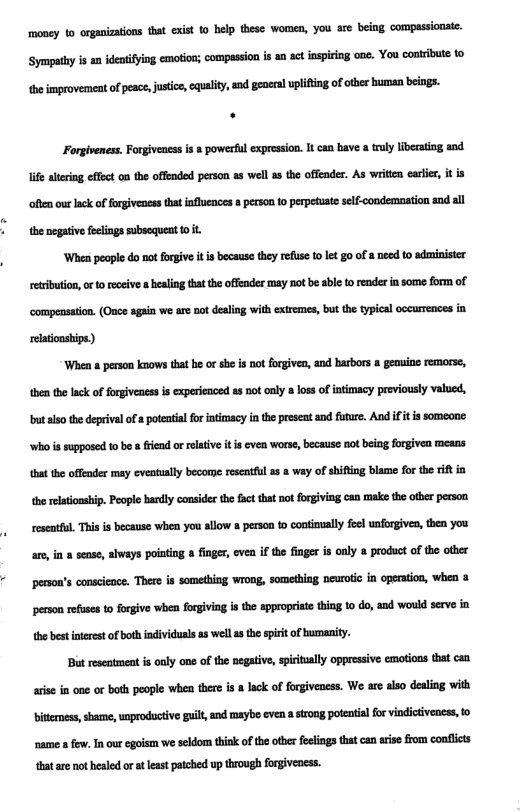
money 1o organizatons that cxist fo help these women, you are being compassionate. Sympathy i an ideatifying emotion; compassion s an act inspiing one. You contibute heimprovemeat of pesce, justice, cquait, and geacral uplifing o other human beiogs.  Forgivencss. Forgivenssis s powestu exprssion. It can bave & ly libecating and 1ife lering effoct on the offnded peson a8 well a8 the offender. As witicn ari it is often ot lack offorgiveness that inlucnces a perso 1o perpeuate sef-condemuation nd all the negative feelings subsequent o it.  ‘When people do not forgive it is because they refuse to let go of a need to administer rtibution, o o rceive a Bealin that the offender may notbesbl o ender i some form of compeasaion. (Once again we are not deling with exremcs b the typical ccurrencs in rlaionships)  ‘Whea a person knows tha h or s is not forgiven, and harbors a genuine remorse, ben the ack of forgveacss i expeienced s not only a los ofinimacy prviously valued, but s the depivl of a potetial for inimacy i the present an fure. And it i someone who s supposed o be  fead o relaiv it ven worse, becauss no biog forgiven means that the offender may eveatually become resentful as a way of shifting blame for the rift in et Thisis because when you alow a person to consiually fel unforgive, then you are, in & sense, slways pointing a finger, even if the finger is only a product of the other ‘person’s conscicce, There s somethng wrong, something neurotic n operstion, when & person refisesto forgive when fogiving i th spproprist ting 1o do, and woukd serve in the best interest of both individuals as well as the spirit of bumanity.  ‘But rescatment is oaly one of the negative, spiritually oppressive emotions that can arise in one or both people when there is & lack of forgiveness. We are slso dealing with “bitterness, shame, unproductive guilt, and maybe even a strong potential for vindictiveness, o mnh.hmufimwnflflmflmmmmmninfimm {hataro ot besled or atleast patched up through forgiveness.
What exactly is meant by forgiveness? Ths i  valid quesion because cbvious anewers aren lways doquste answers. | peak hee o frgivenss in 3 pirial sense. A fogivencss tha franscends the normal socisl laws of cause and effct. The normal sociel {aws of cause an offct means that wrongs and offenses conscquentally produc resentment, anger, bitrness, ejecton,animosiy, vindicivencss, e, Howeve,forgivenes sys: “No. I do ot wantcther of us to cary th immedise ffectof i ncidat o th fture,becauee ourelatinship, our fiendip,ou ntimacy s uman bengs s rete than hee thinga et {hvesten to dctroy them. | willnot accept anger and biterness towardyou. I will ot poiat an {avisbl finger and secrtly hope tha you live in shame. Nor willindircty allow it b nct {elng you  bave forgiven. We have  rlationsip o value, 1 38 long a8 1 am convoced bt you ar sory for what you did, thenth past has o poental 0 sutan a0 emtionalox  In the piitualsease of the word, frgivnessis lfo-afming, ife-murturing. It s hope nsilling expression tat ises sbove theprimiive impuscs of emotional arbarsn. To e unforgiving s  dexth accepting expression. It s damn that lock the sprtal i of ‘emotional and psychological energy.  “Thelove of umanity requies  constant nd commited vigance ver those felings, a5 wel as, behaviorsthat would operteagainst the best ntret of rlaionsips. A srey a8 mmasity bas bocn trined o be civlzed, we st trmin ourselves 1o become mare consistetly bumenized nd spiitualized in oue livng and tretment of ellow buman-beogs. Having o forgiveness i lcehaving 5o salve foran pen wound, I fces the vulnerabilty of bocoming infectedfrom severalsourcs. Assrely a i our wisdom we would not expos the body 10 such threats of danger, ot us in our willingss to lave humaniy, ot xpose the i and cmtion iter We bave the power witin ursclvs 0 overrid the st s of cause and ffect in social relatonshis, as surly as we bav overcome nd conquered ther expresion of natur that ance overwhelms v sncitsncetos. Let s e he power and wisdom of coice, instead o allowing ourssives to be misused or misuse obers by the  vicisitudes of chance
esings that isur your acesplance of tissnd obstrctthe freedom and expeesion o your v self are iraional,terfor aliaate you from your SEL. They subject your i and prcepion o the powerof lsions tha nly undermine your connction 0 the SELF.  Th gou of the SELF i o evolvetoward contntment s happiness. Tis i what macy bave beenblocked rom don becuse they’ve besome alente fomthe SELF. Some basic  Stepsinthe pth to reconnecting (self-love) are:  force. You can evolve,  1. Acknowledgement that you are a spiritally evolving: within yourself and in reation 0 others. 2. 1dentify the thoughts, felings, and beliefs that obstruct your love of SELF and keep s  cloud of self-defating hovering over your mental world.  3. Understand that through consistent effort and fairh i your spiitual power you can  free your mind from sel-defeating emotions, belies, and iusions about your SELF.  4. Have the courage 1o challenge and stand against whalever has made you suffer, fecl unbappy, and unconstructivein the past.  5. Feel within yourself that now is the beginning of your path toward self-love and improved relaionships. B consisten and mindful, but work patienty with yourself.  6. Understand that negative feclings and beliefs are always profoundly emotional and hat’s why ous subeonseious is so vulnerable to them in our childhood aod youth. As aduls we have the power 1o re-examine and reinterpret the past with rational inelligence, and sometimes on the path toward self-love this is necessary. We can’t change the past but we can change the ffets of the past by rejaterpeting the  ‘meaning of our experiences.
You may find it necesary fo reinterpre st cxperiences i oder 10 change he way you peceive yoursef and to cadicate croncous belefs that may have setled in your snconscious without being Filterd through essoing, logi, and illctal dscimination. Learnin to love oursclves i & radua process, b it begins ith 8 commitment 1 scopt urselves nd to b mindfl of how we bav judged and eriicaed ouslves i the st The rinciple of rlnerpretation (understadin bt we ca’t change the past) s tat by citepreingthé mesning of pastexperiences we can changs ur beles st  deep motional  evel and, therefore, change the effects of the past. Assume, for example, that your lifelong.  fficulty with feeling lovable began with your misinterpretation of the meaning of & primary offcion defici. A primary afection deficit s the fesing of being unloved by one or both parents because of thei lack of showing affection, thecfore you develop the unconscious belief a5 a child that you’re unlovable. This belief may persist atthe basc of your emotional sructure until you reinterpret what their lack of affection means. By understanding that it docsn’t mean you’re unlovable, bt that (for whatever reason) they were unaffectionate, you dismiss a negative belief of yourself, This empowers you in other elationships to outgrow he exaggerated and sometimes indiscrminate ned for affecion as 8 pseudo-soluion (o the prmary affection deficit. In fact, by developing  correct awareness through rinerprtation e primery affecion deficit gradualy vanishes and you no longer suffr from an iation, unconscious need to fecl loved by them. You no longer blame yoursef for not receiving affection, This is only one example of how reinterpreting the past 0 feach & more rational and pioductive understanding can change how the past ffcts us. You can examine your owa. i i specific areas hat you need to challenge damaging beliefs. There’s no doubt that the better you relte 1o and understand yourself the more it caries over into interpersonal  reltionships.
To be happy in any rlationship we have to first bave or develop the intemal condition of being happy with ourslves. We could be in a relationship with the most besutiful and  person in the world, bt f we don’tlove ourselves then nothing that person does can  e u et as loved s b o she woukd expect us (o, We may fnd it casy o sy that we kmow a person loves us, but ctaly feling the decp meaing of those words may be an eniely iffrent stry. It can’t b overstated tha the more open we are (0 self aceeptance an sl ovethethe more capable we areof experieeing the decper meanin of being n love withsomeone lse.  Thee’s a concep n Boddism that works very well if you re mindful of usig it “That s i egard 0l negativ feslings and doubis about yoursel st e o.  Acknowledge your SELE. The siitully evolving lfe foce witin you Accept and embrac it s worthy an lovable, There’s o oher rational way o live withourelves or t0 (et 0 ohers ths a who we trly ar a  speualforce itk our own lves.Fres your i from ol llsions of infeicy, mwortiness, unlovablenss, tc. Smply b the self  loving, consirctive force that constittes your rue essence and desie.  CCHOOSING FULFILLMENT  There ace many reationships n sociey that are filng right noy but have a true potentis (0 succeed. What ofen stands in the way of progress i a lack of psychological intimacy and a filure o express one’s deeper, more basic neds to the partner. It shows, for cxample, in  relationship where the husband may take great pride in being able 10 cam & Iarge salary and provide well. That pride in caming potential becomes an emotional value  that overshadows many of his other emotional sensitvites. In other words be becomes partially blind. Tn his focus and endeavor 1o eam he looses touch with s mate’s emotional
values. He fils to see that giving 100 much in one way takes away too much in others. His mate needs and desires intimacy, o spend time together, rlaxed and loving communication, she wants to be with him. And if she docsn’ express this nced o him, then ber mind attempls {0 repress the emotions thatdrive the need. Sooner or late the repressed emotions urge her 0 find ways to compensate for her intimacy deprivation. She may begin 1o eat more, of maybe even shop more, both of which involve a type of secondary intimacy that compensates artifically for a’lack of interpersonal intimacy. The problem with these o atiempts (0 ‘compensate for the lack of nterpersonal intimacy is that they generally become compulsive babits that lock oné info a patiem of self-destruction, .., oo much cating which leads to being overweight, or 0o much spending which leads to excess debt.  It has to be understood that o ttemp 1o artificially compensate for the lack of fulfilment of a basic human need is going 1o genuinely fulfil that need. Without genuine  flfilment it wil always exist as & basic need hunger, an emotional fuilment deficit. This is  ‘why developing psychological intimacy with a partner is so vita t the sprital growth of & reationshi  Suppose the man in the example doesn’t know that his wie or gilfriend fecls deprived of intimacy. He can’tsense it at all because he’s blinded by his pride, or he may be alinated from his own ability to express intimacy due 10 a fear of being vulnersble. Suppose. hat she i too self-ffacing of 100 self-sacificing to tel him that she needs him instead of the bigger diamond or more cxpensive dress this time. Or maybe she knows that h is proud of taking care of her and doesn’t want to hust his prde. Both of these are an obstruction to the potential for psychologicalintimacy in the rlationship.  Peychological itimacy develops out of th risk that we take 1o understand a person’s e nceds and matives. It is an intimacy that says, through questioning what you may not see about yourself, I can understand your deeper needs, and I will do what I can to fulfl them with you. The greatest pat of this understanding comes through our honest knowledge and  understanding of our own basic needs and our efforts to ulfil them.
‘When you refuse to settle for substitution or compulsive behaviors that never really  ‘compensate for unfulfilled needs, but only lock you into self-destructive pattens, then you  are chrasing fulfilment over deprivation. You are choosing satsfuction over dissatifa You are chosing It over an emotional and psychological death. You sre choosing a snse: of genuine inner freedom overthe feeing of being trapped and cramped in a relationship that you feel powerlss to change. If you sureader o the many forms of artificial compensation hat present themselves o us when we feel deprived or unfulfiled, then know that you are tuming your mind, soul, and body over t the uacertainties f chance also. Such 8 surrder will no lead you 10 the path of self-love, success in relatonships, or basic psychological  intimacy in an interpersonal reltionship.  - FOUR -  FROM CHANCE TO CHOICE  Ifthe number of successful elaionships in society s going 10 increase and divorces are going to decrease, then many relationships have to cvolve from ths fleting love by chance to love by choice. People have (o become responsible toward the spirt of genuine love. There’s nothing wrong with being romanticaly attracied 1o someane, or being, infatusted with someone. But when these things are allowed to foste a prélense of love then ‘Something is wrong, as we can see throughout socicty.  1f you think you have to love someone to be in  relationship, and that something’s ‘wrong if you simply like them, then maybe that compels you 10 accept the pretense of love. sk yoursel this question: Do you think you have to be in love with someone f you’re going  10 be ina longlerm reationship?
‘What I refe to here s an unconseious pretense: The desie for nity with  parter i 50 basic to human nature that our minds ar ighly capable of crating the llsion of that unity without us at first knowing i.In today’s sociey this is generally what happens with love by chance. People tend to perceive romance and infatuation 85 genuine love, then the longing mind takes over an creaes the unconscious preteas in effort 10 sustan the llsion. Itis, at bottom, an irresponsible way to engage in a relaionship. You may fall i love by chance, but at sbme point the responsibiltes o love ar going to arise I then that you bave to choose to love by choice or the chance for lasting love with that person will not evolve. To the contrary th rlatonship will be charactrized by emotiona confictand srife o matter how much you or your partner cling to the pretense. There wil be a spirital  instead of afulfillment of the basic esire for unity.  spara  People ift ino rlatioships al the time, fued by th love of chance. They may mary and i bcomes n unbappy mariage. Sooner o aer we may hear bout  loag rocky mariage coming 1o an end. Wella mariage an oly b long an rocky fon or bt pecple (for whatever reason) never choose 1o take responsibily for emotional and sirnal  evolution within th relationship.  Peaple who simply drf into rlationships by chance, never having made the hoice o be responsibly commited o principles, uliling expecttons, efc., ahways leav the door open for rationlzations. Forexampl, they didn’ know you would o woulda’t e  cetain way,or do o not do a crtain thing. So,since they dida’t eally choase 10 be ith a person ik you they feel jusiid in being howeve they wan o be: emotonally detched, adulcrous, unsupportive. The it goes on. In athr words, because hey difed into the elationship by chance they never really commitd to any responsibility i the it place “This is why it’s 50 imporant forus o know whether o not whatever we do i th resultof choice nchuding becoming  partnc n  reltionship.  It goes without saying tha life is 100 short, and genuine love is t00 rare, (0 leave,  eitherup to chance,
There are relationships where diffecences simply can’t be resolved, 5o divorce is inevitable. But forthe vast majority i’s always & mattr of egocentrism and iresponsibility,  and it i those relationships that this writing trics to il  inate and encourage people o outgrow by choosing to be responsible for emotional-spiritusl evolution within their  reltionships and withi themselves.  Leam to appreciate the profoundness of choosing to love someone. Align with your  SELF if you have’tslready, and flfill your search for unty.  CHOOSING THE KEYS THAT BUILD, STRENGTHEN, AND SUSTAIN HEALTHY  INTERPERSONAL RELATIONS  There re  number of ey hing to good rlationships that we ofen hear sbout, but ey sldom give lengihy, srous thaught . ’ 2 though we expect them 10 b simply becaus they cros oue minds s desirable idal qualiis Thesekeys, lthough basic,ae nok Jindamentl vauesin many relatinships. And what s meant by fundamental vlues i that evenin rlaons wher thse Keysar mising ot of pople attempt o gt by withos then.  Of course the llusion of success s aever long lived. These key things are:  1. Communicaton 2. Hoesty  3. Undersandiog o o  5. Timeliness in addressing problems
« Communication in any rlationship is the most vital key to reaizing a porential for  {otimacy, and it s only through communication that inimacy can develop. This isn’tto say  that communication between ll couples is bound (o lead 10 intimacy, but that without  Communication s a path to deepening awarcness of who we-  who our partner is,  and what we have o offer, can receive from, and value in each other emotionally, psychologically, and spiritually. The more open and honest the communication i, then the  clesrer i the pathway — a5 long s two people are not definitely incompatibl. Al of us have heard that a relaionship can’t work without communication, but imagine how many people let those words flow into one car and out the other without any  effect  absorption into the brain or memory bank. In any relationship where there’s & communication defici both people need to try o acknowledge what i does t0 detract from intimacy and happiness, as wel as be conscious of the potential between them that s being.  wasted. There are  Jy 100 many rlationsips where the paenial or happiness s great, Jet thy il to blossom because peopl don’t choase 1o work st communicadon, hoesty. andersanding rst, and imelinss, They don’ conseously make & commitment o xprss berselves,as wella ncovrage expresson romthei prter. ’ 38 though i a reltonship docsa’t come with everying s supposed to bave hen people tolerate i3 long 5 tey can {ben simply move o o he ext ane Lt ifany work o effort i invste. Inscnsc many poople barbo the iden that good reltonships s come ke fst food hamburgers - ready made with all the condimens. The concept of rsponsily working. especally trough  communication, to make a relationship good is hardly considered. In other words, man fecl  hat f they have to work on a relationship and better communication then it’s not really  whether it be lovers, frends, rlativs, or spouscs. Communication s a vial key to bealthy.  interpersonal elationsin all forms and should be ctively valued.
. Honesy is essental 10 8 relatonship’s communication being meaningful and, {bereore, o therelatonship being real. Without homesy the felings snd emotions exsting between two people ar  preense o the pat of one o both.  It can be very diffiul t0 cknowledge that acceping the tnh sbout urslves is & prcequisit to our ailty 1o be genuinly hones sbout who we are 10 otbers. In many catonsips people are simply afsid fo be compleiey honest. Afsid that they may expose hemselves to shame, idicule, ejection, vulnerbily, ec. It could be any number ofthings.  “This is why understanding and trust are so important. Whether personl fears are ational or  not, people are more will  1o be bonest when they aniipae being understood and bave o st n who they expres themselves 0. should be understood bowever, it i any catonsbip we are all at ay given time always vulnerble 10 & number of posible hurs. And it s cngaging and mving forward, despite ulnerabilies, tht chaly cevard us with  thejoys, pleasures, and gits of being intimate. Remember that it is our  ity to grow and be honestthrough love and frction, leasure and pain, success and failure — that allows us o be happy and healthy human beings.  If the communication in & relationship st honest, then naturally the relationshi  ’t well-grounded and is prone o eventually face the condition(s) of turbulence and wreckage. Honesty is & key to building up a relationship’s immune system, therefore o ‘making it not vulnerable to unnecessary vulnerabilitis caused by dishonesty.  Make it a conscious choice 1o be honest and to also help others eel confident that ey can st you with thei bonety, tht thy can expect you 1 st ety o understand  and vice versa, Honest communication promotes rea inimacy.
+ To be genuinely understanding of another human being is to be unselfish, non- judgemental, sympathetic, and sensiively aware of emotional needs. Without being understanding as a matte of choice, a relationship’s potential to succeed and flourish is undermined, and trust doesn’t develop a5 decply as it could. When we setle for less communication and honesty than we need to give or receive, then it incvitably follows that we can expect less understanding to come from cach other. And this transiates ino less trust ‘and affection thah we may personally feel we need or are entitled to. Without understanding, constructive. communication always faces obstacles such as unwillingness, and. being unwilling to openly and sensitvely listen 1o partner’s communication s selfsh. Being uick and repetitve at inierrupting, and critcal of a partner while he o she i trying (0 express personal feclings is being judgemental, both of which are symptomatic of having no sympathy. I1s not sympathy in the sorry connotation of the word, but in the caring and emotionslly connected sense.  Feclings and emotions, even belifs, can be very complex in a elationship. Each new. day may evoke something a partner has never fet o expresscd before. Each new day could  be the seed of renewal, or a higher leap in feeling connected to one another. Human beings  don’t function mechanically like well-oiled cogs in 8 machine. We are capabe of expeiencing an amay of iffrent felings toward ourselves s well 3 obers. To be sndersanding . » eltonshp s 1o know this, and o respet human charscer and expresion within ressonabl it Sympathy i sying within yourselfowardyour arner: 1 kmoveyou have or may develo felings and blif hat 1 am not avare of i every iven point. koo tha our relationsip can have psiive affects n you as wel a negaive i (imes. But by being willing o lsen unselfshly, and non udgementaly, and withou ciical nterupton — 1 can be more senstive 1 the strngths and weakoesses of whatver you fel and believe, watever you expos 1o me by communication. By sening Wih 8 consioss  desire 10 understand.you at every point in time, we will not suffr needlessly from the  Jrustration of each other’s feelings.
This type f eauine undesandin i th esutofchoice. It does’t just manifest n & eltionship because two people would do berer with . You have to want it and you have aurtur it muualy as wel s nsefisly. Leave it 0 chance and you may end up being one of those people who sey about a parner, *1 used 1o know hinvber, but now 1 don’t nderstand, How coud belshe chang ke that?”  Commit 10 understanding and emotional sensitiviy.  Trustis intimately linked to the quality and degree of free expression of who we are in  relationship. We have to trus people to care about us. To understand and respect us, ©© be honest and loyal, and 10 not take advantage of our weaknesses. We have to tust people 0 accept us for who we are, cven though change may be a desirable goal. We have 10 trust people o be sincere about the words they use to cxpress thir feclings (0 us. And tis s just o name a few, Trust in  relaionship is much more interconnected to the wholeness of the relationship than many of us realize. It is much decper than simply trusing someone (0 be honest and faithful. How free are we going o fecl to openly express ourselves in a reltionship i rust goes no further than honesty and fithfulness? A companion may be one bundred percent futhful, but stil inseasitive or psychologically sadistc. Woulda’t such an atitude then inbibit ou freedom to openly express our most sensitive eclings?  Trust bas nothing o do with certainty or the absence of vlnerabliy. It simply means st we v wilng ke chance with bvigfih n s we e i, Nobing i absolute about trust. That is why a deep respect for it in any relationship should always be appreciated.  When we find someone that we can trust with knowing who we really are then our quality of self-expression is more lberal. And that liberlness increases our growth and  degres of intimacy in the overal rlationship. Without trust and & mutual respect for it, 3
genuine love cannot evolve between two people. Trut is the foundation of srength i unity.  Iuislike the trunk of a tree that — athough one i the source of connecting many branches to  ‘nourishment, growih, and stabl The stronger we are in our self-confidence and acknowledgement that we have somebing valusble to offer a parner, .., our true and honest selvs, thn the greaer is our  abilty to be trusting and therefore 1o expose ourselves to the vulnerability that comes in all  relatonships. We truly cannot belp being vulnerable, but we can belp nol leting  Vulnerableness hold us back from giving and receiving as much as possible. Be wise in your choice of a partncr, reasonable in your acknowledgement of who he or she really is, and thecefore able to well place your rust  Remember... rust i a keyto healthy interpersonal relations.  Timelinessinaddressing problems s key o keeping conflicts s diffccces from vecoming harbored reseaments andlor represed anger ha i bound to suace soones o oter  Choosing to aveid dealing with conlcs and differences a5 an expedient means of restoring peac is  harmful choic. We can’t esave problens by avoding them. I, ox cxample, ourparnee fequenly docs something hat hs  endency o hurt s, we can’t make the rlaionship beter by repressing the hurt that we_fel. Commuricatio, honesty, understanding, and trst ar nesesaryto our ability to be timely in addressing problens, We Should lways et  reasonabl time 10 approsch our partnr with concerms we may have about relations. We should also ry to be sware that i & relaionship where sdequate communicaton is lacking, two people may ot musually be awar that ane ot he other percives somebing a  problem. And i someone docsn’t perceive something s  poblem,  he partner may assume the lack of perception to be an insensitivity. How any reltionships.
e barmed by i rordue 08 ack ofimely nd hooest commurication?  Thes five keys: communiction, hnesty, understanding, s, and imelines e il {nterelted nd mutually dependet o each othe for the suceess of a relationsip,but ey e ot the oy keys. This small booklet can’t covr thescope of everyting in 50 e pages, bt i s weiten o encourage isigh and more consiructive interet in how we relate to seve, ue pastaes, and ot peopl n socity. Be mindfuloftem and aply them in  ‘your daily elation, especially with your petncr.  TAKING THE FIRST STEP  “The s siep in beginning 1 love by choice insteadof charce is scknowledging hat our reltioships should not be nelected or taken for granted. We should no leave o prcariouschance what we ae perecly capable of being respasibe o  Loving b choice means that we commit to bein conscios of the necds that exist in  a relationship, and that we act on our consciousness by being communicative, honest,  csting,recepive, undestanding, . I mean that bereand e we sop nd sk ourselves, s tis a reltoship I want o be n o is it one 1 have smply drifed it by chanc? The answe 1 tis question, i bnes,shoud lad o the decpening of  ral commitment, o scknowledgement o & pretctous one. Any relatoship is 8 complte emiona and il vast ifwear ot sincre i I, because profound esonsara’t emed that we can cary ito e future withus. Not sy lessons sboutrelting 10 someone lse, bt lessons lso  about who we really ae.
1) Make an assessment of you rlaionsips with as much honesty 3 possble. What have thy given o aken away fom you i the past six monihs 08 yea? Have you grown o become stessulasa esult of any ofthem? Does & pariulr elationship nliven you, orscemt drain you of mertal pesce?  2) Ona percentage sale, what percnt f ositveatifude, behavir,and responsivencss do you give of yourself in reatonships? Could you do betir ifyour percentge is  lower thah sixty orseventy, and how would things chang  youdid?  3) Do you beieve that relaionships can bo what you make them? Or that they are expericnces that you should et ke their own course?  4) Does your pariner bring posiiv encry o the eltionship? Docs he or she show & meaningful intrest in praciing th keys o a healy relationsig? s he or she willing t do bete if eded?  5) Are you willng to wake up 2 year fiom now realzin tha neithe of you chose fo  give o receive more of what you needed to be happy?  In today’s society increasing numbers of couples in rlationships never work on the, quaitis that promote intimacy snd spirital growth. More and more relationships end up being no more than short lived, turbulent, or carefree Dlngs. We can all do much bettr in relationships if we take responsibility by being honest, genuine, and constructive. When love.  i by choice instead of chance our relationships have a much stronger foundation o stand on.
MAKING AN ASSESSMENT  A relationship can have many diffreat types of effecs in our lives. Certain people  inspie or cncourage us. May influence us 10 feel happy or sad. May cnergize or drain  us. May enliven or depress us. May comfort or anger us. May help us appreciate or regret  knowing them.  Have you assessed any of your relationships latel to acknowledge their meaning,  effect,or value in your lfe? Or do you fee that just because you’re in a elationship, you’re.  it with e hopo of hangin s efects through self-determination o eting out of it O the other hand, have you sscssed yourse el to e how you are ffecting Someone lse? Are you sn insirton o peychic dain on anyone? Be honest with yourse about you a5 wel a5 ohers sbout the conditon of a elatonsip, because anly hrough Honesy can we fiee ourelves from deilatingemosinal shackes andor llsions. We need mostof all o b hones abou o own beliefs and atitdes, because i our thoughts don’t reflect who we truly are, then we can’t really expect to absorb a perception of who others truly are. Even if their reflection is genuine we may absorb it through distorted filters on our own mind, o they may do the same. Relatioships don’t have (0 be viewed duing an asessment s petect orimperfct, What we ned them tobe i posiive and sustaining.  RATING YOURSELF  On 8 percentage scale of ten to one hundred where would you rate yourself i the following areas:  1) Positive atitude and behavior in a relationship?
2) Listening and approprineresponsivencss {0 your artoe,childen, ofherpeople?  3) Honesty in what you say, meaning that it coresponds t what you ealyfecl?  4) Taking conscious responsibilty orcrating th best condiions ina relationship?  5) Beingsolution orentd,instead ofa e blamer or nconsirctiveargee?  6) Being a maker of conscious decisons o give of yoursel, that i, acing instead of impy being sctedon or puled n any dirction by the unpredicablecurnis n 12 16 you rate youref at fifyperct than you can and should o betr. Why wake up  ‘years from now telling yourself that  ings would have been much better if you had given  ‘more, when you can say things have always been good because you gave what you could?  SELF-DETERMINATION  Self-determination s esseatially creating  relaionship by the work of your own  hands, .., the hands of your pariner as well. The conditions in any relatonship, even wi  ourselves, are the product of what we either make them, or, allow them to be. Either we. believe that relationships are what we make them, or we believe that they are created by chance or fute If the lattr is true, then you most likely think that you should let your relationships take their own course. How responsible s such a belief?  If you have a disagreement o argument with someone, for cxample, leting things take their own course s like saying you want the person o go on about his or her business fecling hurt, separated, angry, o whatever, and that whatever happens just happens. Come what may.  Would it not be wiser and/or mor responsible 10 letthe person know that when their hurt or anger subsides you are sl interesed in a positive fiendshiplelationship? Thercby,  you allow the two of you to mainiain a sense of control in determining how the relationship
Wil b effected, s opposed toleting the wrong thoughts and feelngs ake their own course: and unproductively influence th relationship.  Imagine al the people in society who go months or even years without speaking 1o cach other because a disagrecment or argument was lef {0 take its own course, instead of one o both of them using self-determination over how long and how much certain feclings would effect theie relaionship. All the time while they are not speaking to cach ather, n thir hearts they wish they wee.  We should always remember that when we fail o take responsibility on our own, sometimes feclings can take on a lfe of their own. In such a case we may find ourselves a5 passcagersin  back seat wondering where we’ll cnd up, instead of feeling like we’re behind the steering wheel.  Relationships, for the most part, should be a product of people’s slf-determination. Of course everything isn’t controlled, nor should everything be. A lot of things in relationships developed a5 a roward or esult of other conditions. Thisis why we are siways  capable of experiencing spiitual evolution or spontaneity.  ‘YOUR PARTNER’S INPUT  This isn’t an area centered on vulgar material benefit, but moreso on psychological, emotional, and spirtual qualites. What does your partner give or take away from you in these areas? Have you actualy thought about that? O once again — have you just beea in & reltionship because you’reinit?  Just as you should work to honestly assess yourself and reflct who you s, you need  50 onestly asess yourpartnr and allow yourself o absorthe trthsboot i o her.
1 your painer am encouraging o iscouraging influnce in yous lf. Do eating o himorher weaken you? Or does it uild and sustan posiiv quaies i you?  These ar ot questonstht you should sk yourselfevry day or week. Bt they re questons tat you should periodicaly examine. And wherever you fnd wesknesse, disuss with your pstne his or he willngoess o work a improverment. Your parner’s input or output i Baf of what  relationship s o i, will o won’tbe Discussig the keys 10 & heslthy parterdbip i both of your responsibilty. Practcing those keys is both your  obligation tothe rlationship, as well 5 your personal,individual seives.  If your partner is greatly lacking in expression of the healthy keys, and shows 0o inclination to improve, then you can hardly expect him or her to be a part of opening your  oot to happiness.  A YEAR FROM NOW  A year from now you will inevitably be looking back in judgement st the chaices, Iack of choices, and decisions that came 10 pass. How do you expect 10 judge yourself and  your rlations  then? How will your partner judge you and vice versa? Here and now is  the time t start creating part ofthat answer by I  and loving by choice instead of chance. “The last step, when we reach that poin, should be looking back over our lives and, being able (0 tll ourselves that we gave more than average to help our relationships work.  That we gave from the heart what we decply waned others 10 give 1o us. And that was our  Like anything el in lfe, the people who arc good at loving and nurturing themselves and others are the people who work at t. Notthose who simply think it s all  gift of chance.  1 hope this short book is oflasting benefit o many people. Take care,the loving wy.  The Author
Part Two  WHEN LOVE IS BY CHOICE INSTEAD OF CHANCE  IN PARENT-CHILD RELATIONS  C. Anthony Taylor  ’WHEN LOVE IS BY CHOICE INSTEAD OF CHANCE  IN PARENT-CHILD RELATIONS  Inorde for parenthood o b effctive s  constuctively influniial and nururingrol the parent(s) must choose to be responsible and spiriually conscious of a chid’s fundamental emotionl social, psychologica, and spiriual necds. The assumption of being a consrucive and ourtaring parea should not be let p to chance. Chance 35 an approach 1o cild-earing makes parents unconsciously negligent and over-assuming i regard (0 the effects of sociological  influences, conditions, and experiences.
There s in Ameica  pervasive tendency to neglec the mst vl needs of chikdren, with the genral excepion of physiologial neds. Because of tis, millon of childen unforunately grow o hate nd despsethemssies bforethey even esch teenhood. Thiscondiion aone can and does greatly diminsh thei capacity to develop consructve personality s, sef detrminaion,  ‘and healthy, loving relationships. It becomes almost inevitable, then,that unproductive i form or anotheris bound to foliow. In the world of human relations the parent-child relationship is the most obligatory and  sensitive, because of s dualistic requirements. In this rels  ionship, for example, the parents have fo  be contrlling and compromising, whereas in an adultrelaionship the ned to be contrll  ot be considered halthy. The paren(s) also haveto be loving bt irm, guiding and promoiingof el determination, socialy flexile, but aiso morally exemplary, prfeiive but lso tsting where socieal ik areinvolved,f name . And i ither dynamic where  rigid o harmjil imbalance accurs herelationship and the child’sfailepersonality can sufe il o severe detimet. According 1o Karen Homey, MD. (1885-1952) in Sell-Analysis p. 42 “Under all conditions a child will be inflenced by his environment. What couni is whether ths influnce anunts o furhers growth. And which development will occur depends lagely on the Kind of eltonship established between th chid and his pareis o oers around him, including other  children i the family..."  She goes on o explain that: “i the spirt at home is one of warmth, mutual respect and  consideration, the child can grow unimpeded.  Unforunately,  our civiization ther ae many enironmentl fciors advrse 03 chid’s development.”Karen Hormey  I our witnesing of o many children and youth today having ouble,even vioen ives e rquently overook th adberse conditions and early relationship tha stuned tei halty growth. One of the most damaging ye verlooked probles n society when it comes 0 chidren s cmotional and spisitual neglec. Too many parents take for granied that taking care of mateial (physilogical) neds i the ssenc of beng & good paren. Wel that s barly the reality. There
e group of basic needs hat have o be comprehensively understod, addressed, nd nutured. Abraham H. Maslow categorzed thee neds as a Hrachy of Basic Needs:  1. Physilogical  2. Safey  3. Belongingnes and Love  4 Sefeseem  5. Selfactualization  “This is a good point for parents 10 understand and stat from in choasing 10 love their children, s opposed totaking for granted and leaving 10 charic that these needs are adequately met  i theie child’s lfe. We can evaluste number one through supecficial abservation. The others to be  dete  and measured require an actively involved, emotional and psychological relaedness to  the child, This, unfortunately i lacking n too many parent-child relationships, to0.  “Tens of millions of parents simply focus almost exclusively on the materal (physiological)  needs. They therefore harbor the feci  put food on the table, clothes on your back, and a warm  roofover your head. That’s my job and 1 d it wel, 5o you (the child) should have no complaints or reasons o ebelor be problematic or fe neplcted.”  1 tink any chil, given that pysiological necds are met adequately, would g0 a longer  . distance onthe road o helth and happiness fthe scle weighed heavieron the sde of association,  ffection,love, encouragement,sn guidance, o it 6d o the excesses of wlgar materialsm. 18  hilds physilogical needs are overabundanly flfiled, but al tho others in the hierarchy are  neglected the child may never develop a healhy, consrucive seae of dentity, self-determination,  or sense of optimism toward life. However, if need #1 is basically met and two and three are  sufficienly satisied the child wil il more likely than not, develop a stroug sense of idenity,  consructive elinterest, and personal power 0 fuc s through hisorher own flflment of basic  needs four and five n the hierarchy.
Parents st b conscious ofthe fct that thelack of ulfilment of eeds 25 can resultina poverty of th child’spesonalty. An th pavery of pecsonaiy s much mre devasaing tha cconomic. povery or  lack of mateial excss, The povery of personaiy ros the spit in pevasiv vy, making it much mre iffiut o s than el deprivation, Prets bave 1o choase o be conscious of balaning these need flfillments,otherise there i  good chane the child will b negaivly effcted.  Lets tkethe second need, for exampl, the need for safepy. We all know that it s & compeling need. And when a child first interacts with the social world it becomes s o her pimary concern. I is ned st i then the i’ eychic ey auomaically becomes  absorbed by a struggle o create defensive actics and strategics to cope with the environment and.  poople wh cause ansiety, ntmidate, o threaten the chil’s feling of safty. It may be the pareats  hemselves without cven being aware, other adult, or other children. In any event s true hat once  ihe child’s cnergies are directed toward sustaining a defensive structure, ofher areas of psychic,  emotonal-spirtal growh are sagnated.  Because a child docs’t el safe, b or she can’t deelop & sense of belonging and sceptanc, Ifblonging and acsepance ret ter,thn how can slfstem propery devlog? And i efstee i deblaed o ot givn a hance 10 develp,ten it must somebow interfre it e acuaizaton (deveoping and excrsog oe’s plential 1 grow and 10 ove).Let s eveg Jeaveout the facoroflove  1 s important tht parens be mindful of thesc needs. By ensuring that the it wo of e are adequaely fulfiled the child il be eychically fre and securs cnough witkin his o hereift develop 8 besthyexpresion ofthe otber tvo.  Most oftn,though, i the case that most parnis are blvious 0 8 disurbance i these aced flfllments. And what mkes so many obliviou i th fac tha they arc emioally and eychically alinated from their own chidhoods. ey ae il rprssing emations comnected o snfullled needs dring their own childhoods, therefor, ar wnknowingly esranged fiom their  children’s emotional-psychic needs and sensibiltes.
When Love Is By Choice Instead Of Chance in the parent-child r  tionship, the parents choose 1o not pass on 1o their children the relationship inadequacies that their parents or  environment passed on through inadequate and disturbed human reations.  ‘What Parents Must Choose In Order To Enhance The Healthy  Development Of Their Children  1. Parents must choose to be informed sbout the basic psychic needs of human development.  2. Parcats must chose to be an intimate part of ther child’s socialization, not just 8 virtually  disconnected provider.  3. Parcts must chose o be concious ofthe naure of thele chl’srlationsips outside the Home. How i he o she cffcted by peers in school? Teachers? Children or adulls i the commanity? As  reut of scilinercton has th chid developed chaacer trends that  © did xis caliet Hyper-sensiviy, imdocss, wilraval? I, yes, the preis ned (o examinewhen and why o th trnd may develop o rgid ersoalty rai.  4. Parents st choase to b conscous an hones abou the efects of heir own atitude on theiechil’spesonay.  Quoting Karen Homey, M.D. agai  in terms of parenal atiudes: In simple words, they may be dominating, overprotctive, inimidating, imitable, overesacing, overindulgent, emaic,  partia 1o other siblings, hypoeritcal, ndifferent,etc. I is never a mater of justa i  factor, but  that exerts the untoward influence on a child’s growth.
As a resul,the child does not develop a feeling of belonging, of we, but instcad & profound insccurity and vague apprehensiveness, for which I use the term basic antiety. I i his (or he)  fecling of being isolated and helpless in a world conceived as potentally hostile.” Homey.  She expresses that: a child in the above situation can’t relae to people with the spontancity  of hisrher real feclings, but must find a way o cope with people that allays the basi  aniety.” Homey.  We don’t heed o sretch our imaginations very far in order 10 pictue the cxtent to which millions of children are subjected o hostile and non-nurturing environments and relationships in. Society. This is why it is 50 important for parents to choose to be conscious instead of taking for granted thatthey are. Neglect of psychic needs s usually unconscious.  Many pareats who happen to be excellent providers are thoroughly convinced in their minds at they are great pareats, that they are deal. And based on superficial materal observation social ‘workers would classify them as having a good, loving home. The unfortunate ralit is that just because parents are good providers doesn’t mean they’re good parents. Not f they aren’ providing. the psychic, emotional, spiitual necesstis alo.  Understand this: 1 hurts to feel unloved, unwanted, neglected. Therefore, when children develop the belief that their basic needs won’t be fulflld, they repress their consciousness of the  e i onde o cvade the painof sbsence, (fullmen). Many would answes,yes, if you sk e e parens lovetherm, But i ealitythey do no el lovd. To s2,ye, i oly (o mitgae ihefeclings 0 the pain says represed. .  Actoss America there are thousands of institutonalize, delinquet hidren whom i you ask will el you her parens ove them. Bt the fac of the maticr s that many do nok know ther paents. They were given away or sbandoned s babie. They I because (0 scknowedge that they were unwanted o given away would be  painfuly crushing blow o theis slf-steem, whichthey ave lle ornone of ssady, becaus no one ese i their lves hasscpped n and made them fcl  meaningful and lovable.
Likewis in cases wher these il ce ssd 1 b appy and loving bomes, eople re eprssingthe trulh aod iving .  1 neither the parent o the child evenualy ackaowldges the basc necds fulimert- depivtion, tben it ill b pased dow 8  fomil-elsionsdefct o th nest genertion.  Eihr the prent o he chid bas fo brin acknowledgement of the ned 1 he surface 5 3 mtier of coic, o he need il eman epressed by the painof ahscnce and therefre, cotine  tohave an unhappy effect  | The dffculy the paens quenly bave it being et bt their ovn s is oot i theeown desperteatemps to keep i represse from ealic in . Atiudesseve a5 defense mechanisms. Domination, SefRightousness, Indifference. 1 parea-<hild elationships pcentsneed o cxamin bow tei ownstdes woud Tt thrn i hey wer i, This akes  consious willingnes,because you may very wel e up having o thiak (o yoursef: ’ e i buing my chld. ’ desiroyig s o barslf-seem. Because you scknowledge tis does’t mesn you atitude i going (0 change. You il bave 1o make s loving choce o change you rlations with your child, hpefuly before the child’s coping mechanisms bave become so ingrined that they take on the characier of longetem or  permanent personalty trends.  The basic needs in Maslow’shiachy are ndispensible necds. Compeling nceds, with the excepion of number v wich is possible o fulil by achievement o the oths our Bing able to b  loving reltonship with decp cmotions bonds and siital connecedacss can b viewed 15 elfactalizaion. You don’ have to become 8 grea ats, singe, pors supersar, o mystic in  harmony with th universe.
But i regard to the firstfour needs, we either fulfllthem healhily or we eventually end up  tying to compensate for thir ack of fulfiliment in one form or another.  Let us take, for example, the need for belongingness end love in the child. We are basically  {alking about affection. Affection is one of the most  il neds i the human paych. So what appens when it eeiv nonc, o 3 amoont s small at it my s well be n?  Chiden took to their prts, fist and foremt, fr aflecion. And when it i’ coning ovl an exendd o of e, th chd begin 1o develep 3 riry afcion e, .6 the wnconscious fcling o being unlovable becass ane o both preis show £ fecon, o not cough. This wconsious elin, i lingers, venaly besomes  complive e for afection, fo belongingnss, o b sccspec, Th prble s s 5 o  he pn b the basic ned can ot s  fecls unlovable at bottom because of the primary affection-defi  ulfled. Once agan,the problem st be idetiied s the paren’s atitde, ot th childsinerent peng or pesonality. All children are lovabl, and all parens should choase fo sccpt the esponsibilityoflting them know. How mach diferen would it make thesocety we live in? How much more productve the attdes of hidren?  The effec tha nom-affctonate parents can have on @ hid’s personality can be mere serious interms of conscince and scial violence than most of us would vt t0 imagie.  Many childen sop eceving affecton s soon s hey are bl t valk. Depending o the chld’s temperament this has iffrent efets. Some chilren may reeiv it from clsewhere 1 mak up for the parets ndifeence, auns, olde siblings, . But when  child has nowhere i o tum, he o she suffrs emotionaly untilthe mind represses tissensive need and repaces i withan cmoional hardeing o resestnen s the child doest have 0 fel s pain. Now imagine. £ child s foreed 10 be nsasiive 0 itsownpa, how much easier i 0 develop an inseasitvity 1o th pain of obers. This means tha i conditons and rlations persitthat forc the child 1  then the proper development of  sense of conscience  employ repression to evade emotional pai can be obstructed at an carly age. We are talking about between the ages of two and ten, fo  example, because a sigaificant par of having a healthy conscious is being sensitive o the pain and
uferiog hat may b caused by oueown words and stions.  There ace hundreds of thowsands of children scross Amerca whose cmoional and ychological diffcltes can be tracod dieetly back to arly prinary affectiondeficits Many of he childen e vilntand aruly becausefsted of being given afecton when they st began  o cxhibit symptoms of  lack of receiving i, the parents became disciplinaran, punitive, etc. which  + the opposite of what the child needs. In response t0 the parents yeling, screaming, punishmens, rustraton, <t th child develops decper resentment, more aggressive and disobedient behavior. And what is the parent’ response? More yeling, screaming, frustation, and disciplinary effort 10 control, We see here a pathetic cycle that, though seemingly obvious, the parent s completely ncapable of comprehending. On the other hand the child, being a child, s not verbally capable of aying  need some tme with you. I need some offection. I need love through iieraction. The child s only capable of knowing what he or she needs through inherent emotional longings, and when  these inbereat emotional longings are neglected an emotional  curbasce begins. 1t may not it sl immeditely an i most cass it won becomethe s of sciopatbolog, but the primary ffcion-defics, i e ompltly unabaed o compensated for in otber relainship, uecomes a serious problem in emotional development and relationships throughout i, Parcns aeed 1o be avace of this, And they ecd t del it their own primary affection-defct s tat it  o’t unconsciously passed down to their children as a social tai in parent-child relatons. As  expresed carler, parents may think they are doing a perfec job whileall the while the most basic  " pecessities of healthy childhood development are being neglected. " When you make s consciouschic o lve your il nstad ofesving 10 chane hat you  il then that choice alone influcnces you to be more cogaizant of your child’s overall needs, as  well a5, what nurures or disturbs the reltionship between you. It encourages you o accept  responsibility instead of unconsciously being imesponsible. Remember that physiological (mateial) needs are only tweaty percent of & child’s basic  developmental needs.
Love by chaice instead of chance leads 1o & more productive and healthy relationship,  hecfore,  more productive and healthy personality development foryour chld.  . Anthony Taylor  | heard the comment once hat “th oppositc of e i ot hat, bt indifTernce” Mary may notagee, evei L have (0 ponder the validty ofthe satement. But one thing is cetin, ad that ) s tht indirence can and fequetly doss ave a rofoundly negaiv cmotonal efTect on the sevlopmentof chil, How many cildren in Amerie, o the worldfor tat mater,bave et he motionl unger pang of fling unoved o unvanted i thei private thoughsbecause of what \heyperceive s parenal indifTerence? W ca o ven begi o et the mumbe  T stemen tht i ks 0 child i that: " dos’care. Yo’t ot worh my  ime, my concem, my atiention” And many children directly perceive this expression from  indifference. How it effects a certain child depends on their given temperament. One child may  harden his or ber feelings toward the pareni() and by early tecnhood begin to express indifference  oward the parent() wishes o auhorty when guidanc n e is most mporant. Anothr child, in esponse o indifTrence,may make an et effort 1o show hishe paren(s):“Look, | can do ting. i good ot school. 1 won the cones, . And this ffrt t prove him o brse worthy of th parni(s i, concem, aiation, and love may g0 o for month, even years. Ve, ifthe paren(s) {odifcent the child may end up giving sl th stamp of fol  remai - “Ll never be worth  mama andio daddy’s ime,lov, e It the becormes questonabl s 0 wheher of ot the elfesteem ad slf-confidence will devlop in ealhy, constrcive proporions.  On the othe side ofthe coin the pare() may be fsally blivios 10 thei iniffernce and e profound effect it i having on her hid’ pesonality. I the paren() ar obivius, then the  one child’s effort to win their affection, attention, etc, may be viewed a5 10 more than an excessive  need for atiention. The other childs hardening of his or her feclings may be considered as &  toughness o fce lfe. In any event, the child develops sn unconscious resentment over time.
These ypes of occurences would be more unikely ifthe pareni() were loving by choice {nstead ofchance,and therefre, weremore sensiive o their chil’s nonvertal and s bebavioal Jangusge. Thre ar many aduls in soccty who arcuncerain sbout thei own vlueofthe carees, e they hav cnde p in orchosen,becaus s chidren none f their achievereats seemed 0 eam ecogiion from thle parens, Ofcoursc e can ssy “get over it and grow up!” But the fctof the st i hat the bangup docs s, and more parents have 1 avoid being indifferat if we vant & popuion of growing chidren whose ives ar les effced by it Loving by choice s the iffernce bewesa being consciou and unconscous of whether we are being percived 3 lovable sl Language i expressd i many ways. Let us always y 0 be sue we arcommunicatng 10 cildien what we intend 1o exprss. Otherwis, thee live may be misled by the wrong  iterpretations.  A Final Word  A bl loving relatinship i the product of two people hoosing 10 cnjoy snd o witheach e, threore e medium through whih his ideal i sccomplished. ane or both people s the patnr s & means o 8 selfshend, wheher i be maleia o el then he rlationship i esting - st et patilly —on  preense, The potntal, {beretre, o gevine lov and nimacy o row is cbseeted by  dam of idden motives. A only iftese otivs ar mtually recogize and challnged onc they materialze (o ‘awareness ~ can the relationship have a chance to grow. N  We e sl capable o oving guinely when we ar e 10 genuinely be and xpress ouslvs in  relaionsip, A 85 fir 8 the pretcnses of love tha it so pervasively ocey ey o can b augrown i we chooset lve by choie instead of chance, aad i o bl ta ldptimsof thought s expercnce e mea 0 b e aly sy  forus.
Title Pages from Other Works by C. Anthony Taylor  THE FINAL RELEASE  Challenging The Compulsive Criminal Mentality And Staying Out Of  Prison This Time  By. C. Taylor  CHICAGD ABC /o South Chicago ARG Zine Distro 7.0, Box 721, Homewood, IL 60430
Clarence A. Taylor  The Anti-Recidivist Booklet 21* Century .. YOU’LL UNDERSTAND THES TIME  ACALL TO HUMANITY (Talib) C. Anthony Taylor
C. Anthony Taylor Freedom Campaign  This beautifully written, insightful and enormously meaningful publication was written by Clarence Anthony Taylor (Talib Rashid) who is one of the very few prisoners who has been able to overcome self-hate and completely rebuild himself, psychologically. He is an expert in the Karen Homey school of psychoanalysis and. has adapted her teachings to explain modern day social and political reality. It’s really quite remarkable, as he il incarcerated in the hideous Indiana gulag system and has been for the last 25 years on an open-ended sentence for a robbery with an injury which he committed when he was an angry nineteea year old.  Like the “G pumber prisoners in linois, his and several otber ndiana prisoners’ fate is up to a parole board, who only rule on such cases. So, to grant them parole, would basically put them out of a job. 1’s a built-in ongoing injustice. They completely ignore his incredible growth and what he can offer, not only to his community, but to the entire world. At his last parole hearing in the spring of 2002, they claimed he had “de.aons.” Frankly, they fear his intellect and revert to ‘malvolent repression in dealing with his righteous case for freedom.  Chicago ABC has taken the responsibilty to spearhead his Freedom Campaign and we are trying to raise funds for legal fees, a competent lawyer and to attain his much deserved frecdom. His case was replete with instances where the prosecution ignored their own laws, as is what often happeus to prisoners. His freedom can and st be won! He’s the most impressive person in prison that I have worked with.  “Talib has written a complete analysis of his case which s titled “4n Appeal to ‘Reason. ” which is available. He has also written several complete and wonderful novels, which we do notyet have the means (0 publish. This man, in my opinion, is truly among the world’s most important and relevant thinkers as far a5 ‘understanding moden day reality and how 1o become fully human amidst such a sick society. He offers geruine rehabilitation, hope and applicable solutions!  So, we are asking for $5.00 for this publication, which wil go into 8 fund intent on his release. For $10.00, we can sead you al of his present publications, including: The Final Release, The Anti-Recidivist Booklet for the 21st Century, The Politics of Crime and the Crime of Politics, Racism as a Defense Against Self-Hate and Spiritual Humanism. Dovations e, of course, most welcome. Please send cash or a check made out to Anthony Rayson with C. Anthony Taylor Freedom Campaign written on the memo line. Thankyou! Free the Truth!  Write: Clarence Anthony Taylor #13606 Loc: 124R / IDOC / Pendleton Corr. Facility P.0. Box 30 / Pendleton, Indiana 46064  Published on June 14th, 2002 South Chicago ABC Zine Distro P.O. Box 721, Homewood, IL 60430
WHEN LOVE IS BY CHOICE

INSTEAD OF CHANCE

(A Relationship Enhancing Booklet)

By C. Anthony Taylor

Copyright 2001
CONTENT

- ONE -
Page 1: When Love Is By Chaice
Page 3: The Chaice Of Love
Page 4: The Pretense Of Love
- TWO -

“Page 10: The Expectations
Page 28: Choosing A Partner
Page 30: The Primary Relationship.

Page 31: Taking Respousibilty For The Relationship

- THREE -
Page 32: The Concept Of Self-Love
Page 34 The Path To Self-Love
Page 37: Choosing Fulfiliment
- FOUR -

Page 39: From Chance To Choice

Choosing The Keys That Build, Strengthen, And Sustain Healthy Interpersonal

Relations

SECTION TWO

‘When Love Is By Choice Instead Of Chance

In Pareat Child Relations.
WHEN LOVE IS BY CHOICE....

- Foreword -

‘This booklet is written with the gosl of giving readers insight into a subject largely
taken for granted, ., the difference between loving by choice and loving by chance, as well
a5 the development of love by chance into resposible ove by choice

Whether we are taking about loving family, ricnds, companions, or even ourselves,
loving by choice simply adds a more constructive and responsibl nature 1o the relationship.
It ives us the constant awareness that love is worth our cffort, as opposed to us simply

expecting to always be passive beneficiaries.

The Author

“Thers is o perfect love. Ther is perfction oly in the use of our potenial 1o be

predominantly happy with ourselvs and someone else in a healthy relaionship. Perfection

of ourslves in effort to aurture what we want and need in 3.

giving what we need to

elationship. I i not a measure of the reltionship itself.
‘When Love Is By Choice

Instead Of Chance

“The belif in falling in love has been around for thousands of years, but it has not
always been the path to lov in every culture and period of history. Although many societies

o longer practice i, relations

i them used to happen, primarly, through amanged
marisges.

In moder industria societiesthe custom of arranging marings i just about extie,
and peopl ar e up o their own choics and judgemens n inding someone they vl (o
be with, The words, “We fll in love;” are heard more frequeatly than eve, yet the
relaionships are o brief and/or tubulent that you can't help but wonder iflove eve rally
exsted Howi it possble for two people o fll i love and then become esranged fom esch
other 50 quickl? Even in reltionships where mariages remain legaly in tac for years, the
feelings and expressions of love may have long beea gone. Is love trly such a short lved,
‘wavering,and unsable phenomenon? ot ifit s lov by choice intead of chance.

Love by chance, what we generally describe a faling i love, is not eally love at all.

tis romantiallyatracive, averwhelming infatuaion hat peope indiscrimintely sbandon
hemselves 0 with the llsion of ediesly perperasing. Bu ik all e llsons it oo
musteventaly disslve when chllenged by the penciring foce of raliy. The frst of
hich s that romantic inftution does't st very lag, Seconly thy ar o pesonaiies
withinividul prefeeoces and values. Thirdly, on o bo of them may b oo oistc,
caught up i his (or her) own needs, righs, expecaions, wishes, and. demands; 100
{nsensiive o iniffrent 1 the other'. Thi is wherethe rth i found. 1 was neverlove, bt

he attacton of one t0 the other because of the possibilty of fulfiling a selfish need. OF

course this part of it is ot consciously experienced as such, for they are both convinced
through the llusion,at first, that they do love each other.
‘The concept o falling implies instability and irresponsibieness. And it s true that they

can't mutually agree to be spiritually committed to the responsibility of nururing 3 loving

relationshi

of leaming o relly communicate with, understand, know, and resect cach
aher n this regard it shows that a east one, i no both of them, i incapabe of relly
Toving, bcausethey are'taccepting orundersanding nough f themselves. And sine they
have come together through a Aappy g0 ucky, uninformed method of choosing 3 prtner

they've never consciously accepted any real obligation (0, or responsi

ity for working to
build relaionsip. 1's no wonder,then,that when th tme o raly ive of one’s decper
sl 10 accept diffeences with undersandin, 1 see the partnr 45 autonomous, and 10
emotonlly compromise arse - someone s suddenly faling ou of ove,

‘There is, in modern society, too widespread a tendency for people to underestimate
the gret, g personsland socialconsequences of no lovin themselves cnough. I we do
not love curselves thn we are aienated fom ou ru poteniial 1 ove others. Wihout sl
Jove w willabvays ned othes o do for us what we have o done for ourselves, €. 0
afim that we are acceptable, aracive, inelligent, (0 giv us the fcling tat we have
mesning, . This ned will be an cadles divng foce as wll 1 an ndles rustation of
our desi 1o be happy, fo others can't give us what we don't embrace 35 rue within
aurselves, or screly e that we are nworty of

Whatyou would give 10 snothr if you imagined you eally love them, give tht o
yoursel. The forgivenes, undestandin, sympathy, compassion and eocoursgement Have
it i yoursef asyou woud hav i them,and it will natrethe core of yourbeng, It s in

this way that we empower ourselves with the ability 1o choose 10 love.
‘The Choice Of Love

When love is by choice it s a fiee and willing commitment o the process of
otonal and spirital evolution between you and your parner. I st a fagle branch of
man emotion, wagging ever which way and easily broken by the gusy winds o lfe. When
e s by choic insend of chance is ke te... iy planed i the desire of man's
d woman's heart. It grows stronger with time, while 50 much of the world sround it
intgrats nd then givs way 10 other hings.

“True love (s sn enduring phenomenon that begins it two people understanding that
-y can love cach other out of wan, ot unconscious need. With tis understanding they
Ve an opportunity o acceptor rejct a mutual inerest n loving each other. I they choose
ove cach other then they are consciously accepting an obligation and responsibility to
et cenain expectations in the relationship, (shown laer). In this case love s
aphoriclly spesking — child born beweca them, an they el honored o embrace and
ture that cild (lve)fo the duraton of ther ivs fposibl.

1 rue that genuine love can fade over time, bt never quickly. s also true that
antically atactive,overwhelming infatuation can develop ino love by chice Butit i 2
dom occumence,as the divorce rae and ieconcilabl conflit i rlationsips atest 0.

When people ente ino love by choice they are mindful that th parter has bis (or
) own personaliy, values,inteest,etc. I s with the undecsanding that human beings are
A just individuals, but also want 10 be connectd to somcone, understood by someone,
itually embraced by someone. It is with the desie tha, in the brightest andor dakest
ur oflfe, someone who cares more than anyone clsc willbe there. Genuine love never
cjecs s own ead. The type of spiiality mentioned above is the wholeheared, slf-
sbracing cxprssion of one's decpest buman qualies: understandiog, sympaty, jstice,
‘ceptanc, human equality, cmpathy, and the willingness 10 console othes wilhout being

sndescending or expecting reward.
‘The Pretense Of Love

The pretense of love is usually a tactic used by one or both partners in pursit of
flfilling a compulsive, hidden need. I s

a pretense because he (or she) s incapable of
loving, so mustinduce (artifical) feeings oflove i order to jusify fecling enited to certain
things from the pariner. The pretense of love may be conscious or unconscious, but it is
always simed at fulfilling selfsh needs, It is the slfish hidden necds that distort the meaning.
of love and underly unreasonable expectations in the relationship. I'm speaking here of
unconscious pretenses. Not those where someone pretends to be in love for money, ctc.

Here, the person pretends to be in love because the troubled relatonship with his
(hersel), ranging from fear of rejection (o an extreme self-hatred, docsa’t allow the person

o genuinely give or accept love. I is 8 pretense of necessity because it's a natural hums

desite to want 1o be in a elationship where feclings of love, acceptance, and appreciaton ary
believed to be mutval.

Below, 1 will show a number of expectations that you should have in a loviny

relationshi

When love i relly love, (snd 1 will venure (0 s2y thal hre's 0o such thing &
nbelthy, selfis,possesiv love, he you shouldexpect
L. To e sceptedas e minded pata nd uniue individul withyour own want:
needs,and eslings hat desenv 0 be cknowledged snd respecied.
2. You should expect your mate to besenstiv toward you. Wiling (o cxpress his (b
tre eslings and emotinal desirs, and wiling toistn 0 your'.

3. You should expect patience i the search for understanding, and

lingoess o i
resolve any misunderstandings or differencs that may arise.
4. You shouldexpect encomagement when f'schallngesshow that you e i, Help
and support when necessry or when you ke rasonabl request.

5. When yourchoics,decsions,snd actions do or an cause unnecessary bam 0 you
o your parinr you shoukd expect senstve correcton ad consructve s,

6. You should xpect time together, time spet slone, and ime spent with thrs (0 ot
b muualy exclusive,but blanced and fulling. And you should expect each other
o shar stories sbout these expeicnces.

7. Youshouldexpect o be tused instcadof doubied, e

5. Youshould expect hoesty without attmpts o get by with excass o half i,

9. Yo should expecta monogamous sexul rlationship tht docsa' sy rom fdliy.
Love by choic nsead of chance i resposibe anddocsn't give in o tempitin. s
pincipled and views infidely 35 sn unpardonable dishoror 10 one's el ane’s
partne, an the sprt of e relaionship.

10. You should expect spoadic, intnse romance, because genuine love sporadically

arouses overwhelming feelings of appreciation for the person you find contentment

with,

11, You should expect sexuality to be an extension of psychological and emotionsl
intimacy that docsn'tlose its desiabilty, as opposed to sexuality being subsritute
forintimacy.

12. You should expect your mate to understand that material gifls can be a way to show
affecton, but are not snd can not take the place of gemuine affction through

13. You should expect the relationship to give you a sense of contentment and to be
fulfilng, as opposed to being an interpersonal orintrapsychic strain o eiher of you.

14. You should expect your partner 1o expect these things from you, and be desrous and.

frely willing o give of yoursel.
15. You should expect the social and, where possible, economie responsbiltes of the
relationship to be fairly shared.

In each relationship some of the expectarions may usually be fulfiled, others may not.
Can you imagine a rlationship where most of them aren't fulfilled, but peaple stll claim to
be in love? They exist. And it only goes o show how confused people are about the
difference between love and a compelling need for affection. That all human beings need

ove can'tbe disputed. That part ofspirituality i the slf-fulfillng desice 10 love others s ot

disputed. But what keeps a person in a relationship that trly is rot loving and i destructive

10 thee best ntrest emotioally, psychalogicaly, physically, conamially,socialy, andior
numerous other ways? For ths answer we have 10 look at the conditon of the primary
reltionship. The primary relatonship is the one tha we have with ourself. If it is not

adequately nurtured, then our souls will forever beckon for the genuine fulfllment of it

natural longings. The longing 1o be self-accepting, loved, confideat, meaningful o others
because they appreciate who we are, and the longing 10 be happy, 0 name a few.

Its possible that bad relationships and experiences in our youth can convince us

unconsciously, that we wil never flfill these longings. In this condition we develoy
‘compelling needs to compensate for what we lack. An insatiable need for affectior
compensates for love, pride compensates for confidence, sex compensates for humar
closeness. The lst goes on.

‘What's important in a rlationship i for us 0 use the opportunity for emotional anc
spirital evolution. To work toward understanding, accepting, and tring o fulfil our natura
longings in o genuine way, instead of trying o keep repressed the irrarional, unconsciow:
fears that we can't genuinely ulfl them. I¢'s also important hat if we recogaize these fear
in our mates that we try to point them out and build the confidence tha the two of you car

‘work through them together,
To love by choice instead of chance is 1o love with meaning and purpose. It is to

anderstand that nothi

human relations s perfect except our potental for improvemeat

wherever it i

needed. It is not having the expecation that love will be a solution 1o

svecything, but the wisdom and willingness to act on love as we desire it (0 act 00 us. You

¢t give your companion self love, but you can give him (or her) the key fo undersianding
1nd the encouragement that will allow the person to realize that they can give it 0

hemselves.

In any relationship that claims to be serious, another human

can oaly love you
10 the extnt tht they have developed the capacity 1o love themselves. Otherwise you will be
more of & means 1o an end and the relatonship will quickly fade or develop destructive
emotional conflicts. Such a beginning can be transformed into love by choice f the two of
you are willing to embrace the process of emotional-spiritual evolution. You should examine
the existing qualities, values, wanis and needs of & person in comparison and relaion o
yoursel before you enter into a rlationship. I the person can't help you grow emationally
and spiriually, then why commit yourself to the whims of passion. To do so, eally, isa't 3
commitment at all it i & fall rom wisdom, unless a some point thereafer you consciously

commit yourselfto loving that person with all your heart and mind.

- TWO -

‘Some people may get the idea that loving by choice and having absolute expectations

deprives a relationship of spontaneity, mystery, surprise, and freedom, but this isn’tthe case.

‘When love i by choice it s no differnt than any other conscious choices peaple make n ife

experiences human interaction is differen. The way each person experiences the 15 basic
expectationsis going (0 have different levels of intensity and emotion. Every personality has
its own mystery and surprise, its own unigue characteristics

Imagine choosing to love a5 analogous (o 8 sports superstar having chosen to play his
particular sport. The superstar didn'tstart the sport with a passionate love for i, but with &
sense of wha the sport was about and an interet in learing more about it through practice
(experience). The person had to boor cerain practices and disciplines 1o develop a
Successful relationship with the sport. The more devoted the effort and commitment applied
i playing the spor,thef the more passionate the person become in his/her elationship with
t. That passion developed int a positve, enduring relationship, and athough the ruls of the
sport were always the same each game was different from the one before i, In this same way
love by choice with clear expeciations is not going fo create a rigid, mechanical,
unspontancous elationship. Each individual i the relationship s stil free o be who they are,
o express themselves the way they uniquely do in ther own scnse oftime and space.

“The act of choasing instead of justfaling is merely an act of being conscious of the
difference between reality and ilusion. I i being responsible, reasonable, and understanding
The act of choosing docsn't deny the experience of romanticism, nor does it obstruct the
feeling ofa spiritual connection.

Imagine the millions of people i society who e single and lonely because they have
never chosen 10 love. And why have they not chosea? Because they are of the belief tht they
can only experience love if they romantically fll into it with someone with whom they are
infatuated. They believe thatloving relationships only begin wit fire, passon. They may not
acknawledge this consciously, but unconsciously they harbor the beliel. It hardly occurs to
{his type that helshe could meet someone, gradually take an interes in the person, seck to
undecstand the person through coumunication and association, then grow 1o love asthe result

of each person consciously choosing to share that interest.

"
Imagine the millons of people who pass or are around cach olher every day, ye,
because they don't iniialy feel a romantcaly atractive, overwhelming infeuaton, never
imgine that they could lea to love each other in a genuinc way. These are millons of
people who could be in elationships but aren', and is al because of what they fecl and

elieve about the concept of love.

‘The Expectations:

To be sccepted as 8 free-minded partner and unique individual with your own wants,

needs, snd feelings that deserve to be acknowledged and respected.

Although it's obvious that each of us has a history of personal development and
expericnces that bave given us certan beliefs, values, likes, and dislkes, sometimes when we
eater into relationships other people act insensitive 1 this simple fact. Some people see the
‘world and other human beings as if hey were clay needing to be molded into whatever shape.
or form they want or need. To this type of person you may always be the object of negative:

crticism because you don't meet ther standards of pefection or reflect their ideal q

a mate it doesn't matter what you fee s deal for yoursel.
£ person's selfshly demanding of you to be how and wh they expest then (o them
your personal wants, needs, and feelings are a constant cause of confict. You area’t

perceived as a free-minded person to be communicated with, understood, and compromised
with. You are someone that needs to be changed and/or controlled o their liking,

In a geninely healthy and loving relationship, when diffeences arise they are dealt

through construcive acceptance, compromise, or djusiment. Conlict and differences
shouldseldomn i ever give ise o what are ofin calld neconciabl diffrences. Diffrences
are meconcilable nly when o or both people are ixe o being unressonable, iatinal,
or neuroically demanding. Human nature s flexile

Construcive acceptance is the act, first and foremost of scknowledging that your
parners diffrences ar no & challenge to the mesning and value of who you are I s
tooking for ways in which the diffreaces between you can complimeat cach other's
personality, (o that ofthe children i any exist). It is appreciting your partner's acceptance
of you by expressng a mutal acceplance of his or her personal freedom, You can't
constructvely accept something i you say you acept it, but your actions exhibit 3
disociaon from that paricla intcest of your partner. Whether active o pssive rjecion
sl ejecton and it will bave a dampening effect o the emotional intimacy and spiriuaity
n the elationship.

(Constructive compromise is cknowledging that people don't have o think the same
1o be compatibe. It is undersanding that compromise is 8 moralresponsibilty not & mutial
ticense 1 ac s hough imitsand reasonable boundaris don't exist, s acee

things t0a
reasonable degres that you would generall be toally against. As the reader you'll have to

imagine the many posibiltes of things that this could be. One again, if the compromise h

lingering negative feelings or idden attudes it isn't constructive.

Constructive adjustment obviously involves m

some changes within yourell
‘whethe minor or major because you acknowledge that th reltionshi is bigger than it
parts. You may leam thatsome valueoriteest that your partnr has that you tink you don't
ke could be njoyabl (0 you once you engage yourself. Don't b someone snwilng to

‘expand beyond your normal activites. Constructve adjustment i the openness fo become 3

13
sat of, instead of blindly maintaining an atitude against. I's an adjustment that links

ntimacy across bridges within the boundarie of slf-respect.

‘You should expect your mate o be sensiive towards you. Willing o express his (her)
rue feelings and emotional desires, and wiling o listen to your

Who wanis 10 be in a relationship that has 5o emotional sensitivity? A relationship.
where your feelings don't matter? Or a east that's how you fe, o your partneracts.

A man and woman who have & concept of genuine love should be able to trthfully
express thei feelings toward each other snd experieac their emotions without 8oy cramping
anxiety of being hurtor rejected.

1F you're in love, then you should want your mate to believe helshe is welcome o
express hister feeings o you, and you should expect him/her 1o be willing (© lisen o
‘your's. Both of you should be open-minded, seasitive toward each other, nd wlling to place
emphasis on understanding, Is this a command to be pecfect? No. ' anideal to be spiritualy
sirived for as the approximation of your ability o love.

There e a lot of relaionships where love doesn't st but people remain together
because other needs are being flflled 0 varying degrees. These needs could be few or many
of several types, ¢.g,, financial needs, contol necds, prestge value, secondary affecion

needs, on and on. Surprising, though it may b, there arc even people who need o submit

themselves.
In sny reltionship where one o both people are primariy incrested in need
lfiment s opposed to fulling a genine desice fo ove there’s ging o be 8 deprivaton
of honest communication and emotionalsm, Such rlationships ae nvariaby founded upon
pretense, whether conscously or unconsciusly, or began 85 love by chance and never
evoved beyond that sponsibe stats.

People in relationships tha ar supposed to be intimat need o know thei eclings
ar care about. They e 0 felsecure in xpressng hemseves bonestly, and they necd 1
Know tha they' bein lsened 0 and someon’s ying o undorstand. They alo need o
experience the fcling tht thei prtner s willing o expresshim o herslhesty.

‘You should expect patience inthe search for understanding, and a willz

ness o fairly

resolve any misunderstanding or differences that may arisc.

1 ny healty relationship ' easonabe for #person 0 expect 0 be ndersood,and
o expect confliting dierences 0 be patently cxamined. Something s wrong i on or the
ather person has an overbeaing sense of selfightcousness and, insiad of secking
considerte resoution of conflcts, demands tha the parter sbandon whatver posion b o
she bas, To apeny lsten 10 cach oters feclings and {0 reach a mutial undrsandin tha
allows tings o be consirucivly resolvd is aimess. 1s also 8 means of becoming morc
emotionaly ntimate in 8 way that opensthe door 1. piinal comnection.

‘Sometimes its much more difficlt for people 0 acept a ned {0 change od bbis
paten, and ways of thinking han i fo them 0 actully change once they have sceptec
the seed .

this regard that paience should be mutually acknowledged as necessary.
Patience also gives you time to think about what s far, and to become more comfortable

with the choice or choices being made together.

15
‘You should expect encouragement when life's challenges show that you need it Help,

d support when necessary or when you make reasonable request.

To lov i to murture, heefore, when you know your mate nesds n encouraging
Jost you offer it i whatever endeavor he o sh faes I's ot ecessary that you vait 10
e your parnee say: Push me. 1 can't see o pul mysefany furher ight now so 1 fel
e leting go.

1 ot loving for you to watchhim or ber become deeated by doubt of the under
alaton of themselves when yo, while sanding o th sideline, know that your paroce
st inne qulites 0 accomplih,an you beieve hat il madge o 3 few encouragig
ards will make 3 workd of diffrnce. There ar so. many people Who could bave
“complished so much more withthi minds an lves ifanly someone bad taken 3 itle
meto cncourage them,or o belpand support ther.

I read in wrie's magazin that Stephen King’s bestelec Carre was trown in the
ash by him when he originaly wrot i s short story. His wife happeaed tose it and
alled it out. Afe e

¢ she el it was good sory 0 sh encouraged im0 resume
S tum it o & nove. As we sl Know now, it became besiseling book snd 3 movie. But
s consier It was 8 stocy Sephen King lost it i and discarded in the Kitchen rash.
uppose bis wifehad smply breszed through the pages and though, Stephen’s throwing &
aod story away, hen deopped i bk o et hese? That'swhat most people ol
ave done, But she chose o belp b hsband edeem bis it in Carre andencourged him

> make it an even longer story.
The point s that » ltle encoursgement ofin makes the difference between
phenomens! success snd frstrated quiting, There will b times when your partner nesds
encoursgemént and support, Be open enough to be there whethr ' reqested or ot and
nurue your partner'’s dreams, ven when be o she. may have premateey lost it

Remember Carrie.

When your choices, dcisions, and actions do or can cause unnecessary harm (0 you

o your partner you should expect sensitive correction and constructive criticism.

None of us re perfect or omiscient 50 t's & fundamenal flaw in expectations and
tandards 1 think that o parne shouldn't make s han pefect chocss, decisons, or
Havelss than prfect behavior. To be human is b flible. s o be, in realty, ifeong
sudent of e

1 rlatinship you should not expect o be insensitvely criicized, ridicled, or
browbeat because you make & bad chice, o occasionally don't ct 8 neligently ss you're
capaleof Threarc so many peope who give athers no room for e that relationships can
sometimes fe ik sright jackets. Relationships ar ot prncipally abou iving p to the

standards of pecfection that others bave, but

with others the
standards you can mutually agree on fo create and sustain equal respect and barmany.

A person that loves you is not going to want o emotionally sbuse you for any reason.
‘You may sometimes be forced to face growing pains, but never wil a maliious intent be
involved that simply arises from the partner's newroric ned to b sadistic.

‘What you must leam to do i to distinguish the difference between vindictive and

consiuctivecritiism in rlationship.
Vindicive crtism is intended o hurt you emtionally for o living up 10 your
cter's demands snd standards. They may even b demands and siandards neve discusicd
chween you Standards of perfection being simed at thers ar ofin unconscious, because
e Kaow in our conscious minds tha such sandards are ratioal. Vindiv critiis is
aly o paying you back forsuch things s nslin the partners pride inpefeton. I such
eatonhip you ar actully aly peccived s an extension of i o be,herfor st b
aade i thei image, o crticzed orbeing anything diffrent.

Consructive criicim, in shor, pints out weakneses and srenghs nd cacourges
ange r progress It s mindflandsensitive,allowing you o felcapabe of bilding . 5

spposed to feelng as though you'r being tom down.

You should expect time together, time spent alone, and time spent with others (o not
‘b mutually exclusiv, but balanced and fulfiling. And you should expect each other 0 share

sories sbout these experiences.

Socializing is & multifsceted thing in buman relations and like ina other arcas ofife
Some degree of balance needs to xist. Spending time togetheris ideal i any relationship, but
it should not exclude other forms of human interacton such as speading time with fiends

and family.
A possessive partaer will tend o try 1o exclude other people from your ife but you

Should be independent enough in your thinking to pursue balance in all relations that is

healthy for you, and fre from artificil restrictions.
There's a widespread tendency among men i socicty to be imbalanced in the sense
of excluding their wives or gidfriends from thei social lives. They seem to harbor the
unexpressed philosophy tha the woman's responsibiliy s 0 accept th partof the bacon that

they bring home and be there when they are needed, primarily to il sexual urges. This s

trditonal pattern in many socitis where women ar virually considered assets, but in 3
sender equaity cultur i's viewed asreactonary, s socalizing deficiency that necds to be
outgrown orbealed.

We can probably ot begin 1o count the number of relationships where women
commitied infdelity because thy were motionaly depeived in a relatonsip. The man may
protst, I gave you everything. How could you do his fo me? And the typical response s that
he wasn' there. Some other man gave her what sh really needed: Social ineracton, ime,
and affection. Those bsic cssenialsthat give subsiance (0 the idea o being lovd. Spending
time witheach otbee i part of fuliling ripod that shouldn’t b neglcted.

‘And then we come to the self-embracing need for spending time lone. Yes. Being
abie and wiling % spend time lone s a imporant a5 the other fwo points. We need 0 be
slone sometimes to reflct on who we are with others. To try o see where out emotional
connections realy are. We also need to b slone somelimes fo selfdiscovery, 10 idle
ourselves whether in @ moving or motonless meditation 0 look at the world within us and
sroundus.

1 any heslthy relatinship you should expect balanc (0 be rspectd, and that nonc

of these areas dominates to the exclusion ofthe other two.

vi

‘You should expect t be trusted instead of doubted,

[
“To trustsomeone simply means one thing: to beleve in theie oyl and itegity
owardyou. It s very it o tink tht genuinelove canexistwithout (st Bt since e
‘2t define love in absolue erms some aspects of it can only be undersond by looking st
abjeciv reltons. What we assume here s that everyore values being trstd in any

clationship that's supposed to be meaningful, and that being aware of not being trusied

Sistrs the wel-being of a reltonshp.

Since love is supposed to be & consructve, posive force you should expect 0 be
std nstead of doubted, espeialy i you know th doubt areunfounded.

Love must have living substance 10 be meaningfu, and knowing and fecling tat

someone believesin your oyalty and integrity toward then is soul-nurturing.

v

‘You should expect honesty without attemps to get by with excuscs or balftruths.

“The mor capable we re of being honest with ouseves, the mare hones we ar
thers. I 8 sense this is a complimenary dynamic. We have 0 b bl (o sceep our own
s and weskacsss before we are tuly s enough o accep te vulnerabily of
xposing them to others. (There may b exceplions,a n al cases,but hce we deal with e
).

What undeies tendency 10 make excuss is some iraional ned 10 avoid sesiog
he truth abou our sctions o mtivs. Wit undelie he tendency 10 shvays (0 et by i

the unwillingness to accept responsibility for our own lives.
If we're in a relatonship that we and our partner simply fell into, never having,

accepted any conscious responsibility toward each other before or aflr the fll, then it

shouldn't be hard for one or the other person to see why cheating is ofien excused s
something that just happened. No one thought it beforchand. They just fel in bed with
someone else behind their parine’s back. Of course, afterwards they took responsibility for
discovering ways 1o keep it hidden. Or they tried getting by with excuses or finding fault in
the partner they were supposed to be loyal to.

In eny relationship where honesty is supposed to be valued,intentionally teling a half
ruth s equal o teling a le. A half ruh i an atemp (0 get by.

Being responsible is enabling yoursef (0 tell and accept the tuth, even if you have to
Lt someone know it's hard for you t0 do.

‘Without honesty there can be no real growth or bonding in a relationship. What will

exist s the pretense of being close and open.

X

You should expect a monogamous sexual elationship tha doesn' siray from fdeiy
Love by chaice instead of chance s responsible and doest give in to temptation. It is
principled and views infdelity as an unpardonable dishonor toane’sslf, oe's partaer, and

the spirt of the relationship.

Ithas already been said that people live together, mary, and even stay inreltionships
for ot of easons other than love. Many people may say I'm wrong, but I sincerely beleve

tht real love leaves no room for surrender to temptai

. 1f we e genuinely o love i

person, then we must also be spiciually proud of the reationship. Proud of our partner for
loving us and proud of ourslves for being able to love them. I's not an arogant, egotistic

pride, but one imbued with gratefulaess. The honor one must fel to be in such a loving
latonship has to give him o her & sense of responsibilty toward kecping it healthy and
il

A love that can't deter a man or woman from being adulterous is & love without
ubstance. It cannot be living love, and therefore cannot be genuine in the sense that we
ould view love and place realistic expectations on it

What people need within themselves and what a couple need from cach other exist
ithin all of our emotional, social, nd spiritual essence. All we have (o do in relation to
urselves and our partaer is be committed (o the spirtual work to bring our potental to
‘iion. Where there s love we do not ned o go outside of a monogamous relationship if
ve have been mindful of emotional and spiritul evolution

To love by choice is o be consciously committed o the responsibilty and principles

afthat love. I o ahaays honor the belief and trust you want your partner 10 have in you.

You should expect sporadic, intense romance, because genuine love sporadically

arouses overwhelming feelngs of sppreci

i for the person you find contentment with.

ik w sr well aware sty i ot actally ot relationsips begin with &
bombardmeat o romanti expresion. Bt tis phase i sualy illsive and shot Ived. It
st ong, whebe it be 6 monts o 18 mondhs e 8 commitment bas been made, that
someone s wondering why and where the omance weat. What i really worh wondering
bt i how, afle s0 many generions of dissppoinmen, o many people sl expct

romantic-iniiations 1o be & sustined bigh, a shot of cmotional ecstasy that won't wear off.
Romaniic-nit ally

jon at the beginning of & relationship is usually the ari
beightened expression of affection. It is more factcal than actua affecton. Tactical because

i, in essense, & means to an end not a genuine expression of appreciation for who you are.

“That end i geting you to exclud allater possibilifes and commit yoursel (o this soe
elaonsip a glfend o wife, boyfien or husband. The tactical-omance s the pretensc
ofbeing bl fo b affecionste when, i elity, th person may be afid if ot incapabe
being affctonate n orde oty b afectionatc we also have 0 pen up 1 ourown teder
felings, snd many peope re not eady (o accep vlnerabily.

I eltonship where genine ffcton exist,romanc s & recuring xpresion of

appreciaion for who you are and what you mean 1o your partner I s not & tactical means

hat disppears when the end s achieved. Romance should never disapper from &
elaonsip where two people are capabl of showing love o cach oter I should have
sporadic ecumences that bubbe up from someone wha's peridically overwhelmed by
fesings of sppreiaion for being withyou.

16 your partner has diffiuly being romantic and showing affction then you car
suges tht it be iorked on between the two of you. Even condiioned tendences (o e
afecion can be otgrown. One of the main points i that, in your wis for affction anc
omance from someone ls, be hanet bout whetheror ot you'r capable of gving it anc
ofelly having posiive felings oward hat person yourself

Being content with you parter dosst mean you'r n absolue harmony. It mea:
bt the fwo of you havea basi canidenc i each other, that you can grow with each ol
i peace and through the fictionsof [, and that cach of yourpeeds re saisfied thoug!
mutial expresionoflove and affcton. This s your eduring fomanceif you s it throg)

the eyes ofyour soul instead of through the lens of a Hollywood camera.
X1

You should expet sexuality to be an extension of psychological and emotional

intimacy that doesn't los s desirability, as opposed to sexuality being & substitute for

intimacy.

Sexulit s an importantpart of rlationships, but in many it s too significant for the
wiong reasons; for example, a5 a compensation for the lack of social interaction, or
substtte forintimacy. In many relationships one o both partners doesa' have adequately.
developed communication skill. This lends to a diminished capacity o experience emotional
intimacy. In such elations sx takes the place of communication as a symbolic gesture of
wan to be close t0 you, and for us o feel good together.” The problem is that sex in this
capacity doesn't actas n expression of emotional itimacy, therefore cant deepen spiritual
connection because spiritualiy evolves out of higher emotional development. The more we
are hung up on debilitating and neurotic emotions the less spiriually connected we are to
others and the world around us.

In many relationships sex is unconsciously used as sublimation for the release of
emotional frustrations buil up from 3 lack of affection. A relationship based on love by
chance may begin with frequent, passionate sexual encounters. But then it subsides and
becomes less frequent unti, in some cases, it is only engaged in as a rlease of affection-
deficit frusrations. The person who uses sex in this way may never be capable of oblaining.
ceal affection because of his or her insecurites. Isn't it a tragic dilemma that we can fear a
thing that i so esentia to our sense of emotional well-being?

“The point s that you should expect affection 10 be expressed toward you in more,
Wways than sexua, for even sex isn't necessarily an expression of affecton if it is simply &

release of your partner’ frustrations.
To love by choice is t love with awarencss. Being aware of your parner's needs as
well as yours. And being aware of the need (0 discuss or change one of the other's feclings
and responses to needs if they aren’t being met. Don't acceptor allow sex to function a5 3

substitte for mental and emotional itimacy.

X1

‘You should expect your mate (0 understand that material ifs can be a way o show.

affecton, butare not and can not take the place of genuine affection through socalizing

Once again you have to be aware of when your pariner (or maybe even yourself)is

affecton and substituting it with material things. The occasional gi

avoiding. but

never the candlelight dinner, o movie, or walk in the park. This is the same situation a3 in
umber X1, only diffeing. Your responsibility o the elationship is noless important though.
‘You have to be able o offer what your partner needs and to ask for what you need. Always

patiently challenge conditions that harm the emotional-spiitualevolution of the relationship.

Pt

You should expect the relationship (o give you @ sense of contentment and 10 be

fulfilng, as opposed to e

i interpersona o ntrapsychic stain on ither of you.

25
The experience of watching yourself grow closer to another human being in friction
as well as peace is upliftng 10 the soul, and ia 00 way takes away from your ability to fecl
content. You should expect to bave a sense of contentment and flfillment if you're in &
loving relationship.

‘Constant inerpersonal conflits and mental strains within yourself are 3 sign that
emotional reasoning is not operatng as it should.

You bave to take responsibility once again for determining Whether or 7ot you and
your partner are capsble of getting over the difficulties without one or the others
unconstructive sbandonment of sef. If this iso’t possible then accept the need o move on.
There are a lot of people i the world who are much more compatible with you. There are

already too many people in the world fixated in relationships that aren't satsfying or

consirctive o them.

X

‘You should expect your partner o expect things from you, and be desirous and frecly

willing to give of yourself.

18 shoud not be bard o understan that veryting you expet in 8 relaionsip may
e cxptedofyou And ifyofel incapabe of mecting those xpectatons, o unwilg .
hen bave the courage o ak yourself why. Remember that when you love by choice you
consciosly aceep a obligation and esponsbily fo b as murring and ulling t your
parner s you ned and cxpet It too asy o peopl f be oblivious 0 the necds of &
patner i ey don't e nto elatonsip with desivs o ive ascqully 3ty vant 0

be flfilled snd given to.
XV

You should expect the social and, where possibl, economic responsi

relationship o b faily shared.

We are peape living i society where gender equality has considersby been
approximated. Men and women arn'ta elegatd to gender roles s they used o b, This
20t 0 52y, however, that women in the past haven't conributed 35 much a5 men
rlationships. Fai disrbuton of responsbility and resourcs in 3 rlaionship should be
expected wherever possible. Each partnr has o willingly embrace a responsibilty toware

the best interest of both

Choosing A Partner

‘The desire to feel uified with someone is one of the sirongest motivations in ou:
lives. It s in the higher rankings ofall emotional-values. Wh s it then that 0 many people
tend to b iresponsible n choosing a partaer? Some peope end up in relationships over anc
over agan thatace doomed before they begin. I’ oaly a mater o time before the blinders o
tactcal-romance and ideal-impressionism wear off and the picture of reality look:
increasingly unappealing. You think someone ist't who you thought they were, whill
downplaying the truth that they really aren’t who you wished them to be. A wish o stron

that you acted on it as though it was already true.
The mumber of peapl who never consciouly choose # paroer, but alvays tend (0
simply drf ot rlationships would probably amaz you. What inlucncestis tendey 0
i is a ack of discrimination i the sarch for unity.

1 order o responsibly choose parter we have o havesome knowiedge of who we
el ar and wht our bsic values ar. Just s importandly we eed 1o be responsible
cnoughto find out if someone else leady has the qualiies and emotional-valus we want
1nd need 10 be in parter, Entring into relatonship with the hope that someone will
oecome your dealmat (who s fu from sctually beog ) i ot acing wisely o responsily.

s

on vishes that ar equatd with eliy.

Take some ime o think sbout and wrtedown te qualiies and motional-values i a
man or woman that you Know would be compatible with your own qualites and vaues.
Whea you are consdering a rlationship be conscious of whether of not helshe s actively
expresing these hings. Why wouldyou commit 0 someone, fo example, who does't alk
about the valu oflove and undestnding and hardly exprsses iterof them? n fct, with
few excepions, may seem incagabl of expressing them. 1's good o sec peope it s who
and what they ae, and not what we want them 1o be. Choosing should be based on
{nteligence and knowledge ss much a5 emotonal-vale to svoid lck of discriminaion in
{he serch or unity. Thre's awaystime for emotonalism t become grossing and fr the

spiit of love 1o take over... after a wise choice.

‘The Primary Relationship

Evaluating Yourself

s stated earler, the primary reationship is the one that we have with ourselves. We
relate o our own selves in the same ways we relate o other people. We can be kind or cruel
1o ourselves, compassionate of tyrannical, patient or sadisicaly demanding. From the lowest

o the most extreme

gree accept o reject ourselves; love o hate ourselves. The primary
relationship operates under the same psychic laws as allother relationships.

Before we become involved with another person in 3

y that may be lasting or
serious we should try to first honestly evaluate how we relate 10 ourselves. Entering into an
interpersonal relationship means three dynamics are working: (1) How we tret ourselves, 2)

How we treat our partner, and (3) How our partner trats us. Al three of these things cflect

the heath and emotional-spiitual condition of our lives as they intersct.
Evaluation of the primary relatonship requires responsiilty snd honesty. We simply

have to look at our lives and queston the

stng realiy. Am 1 saisfied with how I treat
myself? Do feel like I respect mysel? What is missing in the way I elte to who I sm? Do
the feclings and belifs 1 have hold me back from achicvement and happiness? We have to
realize thatthe condition of the primary relationship is what significanty adds to and/or takes
away from our ability to enjoy all other relationships before anything else effects us. Because
of thisit s essentialthat we work at making the primary relationship a oving one 50 that we
can be more responsibly loving in other rlationships, as wel as toward ourselves. They are
always interelated, each efcting the conditon of the other. The less loving you are toward
yoursel in th primary relstonship, then the les you'll expect othersto love you or trat you
Tovingly.

1f you leave the primary reltionship up to chance then your

is over influenced by
beliefs and emotional conditions that have irmational control over you. By choosing o be
responsibl forthe primary rlationship you have the power (0 change yourself and o change.
how other people relae to you.

‘From Chance To Choic

Taking Responsibility For
‘The Relationship

Even love by chance has o become a love of esponsible choice sooner or late if it's
goiog 1o thrive, 1o grow, fo spiriually evolve and involve 3 mutua, healthy emotional
stachment. Many people don't understand the differeace between chance and choice when it

comes to how their lives are being directed. In this scnsc they unwitingly neglect taking &

basicresponsibility for elationships. Other people and external events acton them frely ad
they can end up spending Iotof enecgy just rationalizing and/or coping.

By moving from chance to choice you take responsibility and acton the world sround,
you. You control how extemal conditions and others cffect you. Maybe you can't always
contol the conditions you're subjected 1o, or how certain people treat you, but you can
always control how you are effected by having the will and using your power o act on
yourself and lfe. I is your choice. You don't have to be a passive objectthatcircumstances
‘and other people act o as they wil. By taking responsibility you become the main actor and
diretor of your life, and this gives you an opportunity 1o have equal creative power in
relationships.

Taking responsibility for relationship means developiag anidea of what will make &

elationship work with the person you're with, Becoming conscious of nd active in flflling
essential needs, and working on the emotional-spiritual evolution within yourself and

between you and your partner.
- THREE -

‘The Concept of Self-Love

“The condition of our relationship with ourselves 15 wel a5 other peopl has grat
el 0 do with whethe o not w love urselves, Let'snot confse egoris and narcisism
it el love becaus they aren' exprssions of selFlave ot acully symptoms of a ack of
ltiove

Sefove s basicallythe findamenal scsepiance of ourselves ss mesaingfl, worthy

human beings, capable of loving and being loved by others. It involves the fecling of self-

espect anda constructiv iterest n o growth and pursitof happness This groweh st
meant i the senseof sccumulated chievements o mateia welt,because pepe who hate
{hemselves can dobothofthesetings. It meant i the sers ofdeepening ou spprciaion
oflife relationships, nd the oy hat bothcan give s i 8 way hat nhin el wil Sif-
love has nothing 0 do witha inflaed o0 oran ndervalu of oihe human beings.docst
involve an srrogantprice I can't sy that s absoltely mpossibl o e loved by others if
we don'tlove ourslve, but theoreticallymany have held it o be true. 1 will ey tht nor
loving ourselvs defintely makes it more ifficul o lve others.

In dealing with the concept of self-love we need to

inate as much vagueness a5
possible. | refer to the self a5 an acronym symbolizing the words spiritually evolving Iife

Jforce. Bach of us i, in sate of ealth, a unique spiritually evolving e force. And when we

hear or say that someone has lost their self, we're actually stating that someone’s spiritual
freedom and evolution have been obstructed. Unfortunately for oo many this obsteuetion of
the SELF begins early in lfe because of unfavourable reltionships that disturb our self-

perception in the primary relationship,

how we see, understand, fecl about, and treat
ourselves, as well 15, how we reate 1o others and the world around us because of our self-

perception. .
Selflove is the product of our natunally unfolding psychic progression, but that
ogresson, if disrupted before we are mature cnough o develop ratonal emotional
<asoning and itllgence,can obstnuct the evoluion ofthe self by disoring our percepion
it Instad of fundamentally secing ourselves a lovabie and construcive, fo cxample, we
Sevelop he lusion of being unlovable and worlhlss. We lose sight of the true mature of the
elf, The self is like radiant sunlight set against & clear blue sky. lis warmth and ife-
ambracing power can be blocked off or temporarly obstructed by clouds, but when the
clouds pass over we see that the wamih and lfe-embracing power is sl ther, just 35
adiant and bright. In our minds the clouds that block the self ar negaive ideas, belies;
destrctive emotions and bad relationships. But when these things have dissipaed or passed
over like the clouds in the sky the warmih and lfe-cmbracing power of the SELF can be
ealized. The SELF, contray to delusions (misiaken beief) created by negative thiking,
low esteem, e, remains as unbarmed and lovable as it i atbith, The SELF is always pure
and interested in construcive growth and relationships.

Understanding this reaity can help us reconnect with instead of reject our SELF,

because it is tagic, one of life's greatest tragedies, 1o be alienated from the spicitully

evolving lfe force within us. Such condition s the antihesis of elf-acceptance and sclf-

THE PATH TO SELF-LOVE

1£ we do not choose to love ourselves then we chance the rsk of never being abl to.
The path to self-love s the path away from self-denial; the path away from not accepting
ourselves a5 much as we should to achicve genuine happiness. It begins with the
acknowledgement, no matter how, when, or where, that you were borm lovable buman

being, and witkin you is a spiitully evolving life force. Any idess, beliefs, thoughts, or
TO LOVE HUMANITY

How do we go from loviag ourselves and our familis and companions o loving
‘bumasity? Obviously, loving humanity i a iffernt type of love than tht iavolved in close
‘personal elationships, 50 we ncedto develop a clear mesning of wha i i fo love umanity.
Ina seus, this s a type of love that transcends sef-interst, and t mus, because we cannot
rationally expoct humanity to love us back s requirement or s o love it

“The truest example 1 can cal to mind of a love for bumanity s that cxpressed by
Jesus. Now, th poiat s not whether you beleve he was divine, God, prophet,just a man, or
someone who never existed. The poiat hee i the-message and lessons attributed to him in
e bible, The messags of Jesus wasthat we shouid love e another as he exibitedlove, and
that withoutloving one another we caanot know God. In esscnc, hi s the message of most
rligions, but we bave largely become alicnated from e essences because of our
preoceupation with superfluous festures of rtual practice, o external characteristics ha in
a0d of themselves have litle real meaniog. In essence, al buman beings arealke. We ae not
different specis. And what does differ among us are charactristis that bave evolved over
thousands of years a5 & result of us having 10 adapt 10 different means and methods of
survival, Cultues, as differeat s they are, do not make buman beings differeat rom cach
other n essence. I esseace we all have similar uman needs: social, pychologicl, physicl,
emoional, and spirital. Buteven i knowing this,history has shown that we will ot socially
and philosophically acknowledge it and realize its meaniag o practice until we do 50 a1 8
conscious choice. The love of humanity simply will not develop as a product of chance
encounters; chance living in close proximity o strangers, foreigners, other groups, etc. We
must choose to b reasonsbly accepting intead of rejecting, kind istead of crue, pesefl
instead of indiffereat and apathetic. We must choose o sce others as ourselves and as baving.
the same human essence as we do. In tis sens, the love of bumanity s the highest, most
deeply held ideal withn cach of us. But the cureat world o relations has humanity far from
relizing it

We live in & world today, and long bave, where a large part of humanity remains
divided and i conflct with ofhers over cconomi isues, e, over the basic concemns of
buman survival on the one band and pure greed o0 the othe. In one place neary caire
oations of chikdrenarestarving to dath, while n snother parentsspend thousands of dolars
year providing their children with the unwanied excesses of material sbundance. Toys that
are examined ance or twice in curioity, then thrown iato the back of the bedroom closet.
Clothes that are never wom. So much food that the childen are uowitingly catiog
hemselves into absurd levels of obesity and poor heath at younger and younger ages. In
large part because of emotional hunger, What i even more disturbing sbout this s that most
parents take more pride in being abl to afford such waste in exces tha they attempt 10 carm
by helping a less fortanate or deprived child somewhers els in Americaor the world. Yes,
there are millons of bomeless and impoverished children in Americ, 00, who aro art of the
s0dy and lmbs of humanity. Why are so many well-to-doers indiffreat toward thex? Wy
we they scomed as though they are somehow patly responsibl for teir deprivation and
soverty? How many percats, wealthy beyond the messure of ven forure needs, have reached
it in compassion to provide & poor child wth new clothes fo the school year? It essental
hatin choasing o love humanity we think of compassionate ways o embrace i. Withost an
ocreased expression of social love and compassion toward children, we become a socity
‘more and more condemned by the development of an inceasing mumber of indifferet,
salous, and inseasiivepecsonalitis. Sociey as & whole must s self s esponsibl fo all
of America’s children, and it must work towand the development of an ethos of love and
sompassion toward the it ones. Choose o lov a child that you know is not being loved.
We liv in ime where we need torealize more than cver that the problemin the bouse next
door can eveatually become the nightmare of countless ther people. And we 88 & society
have witnessed this over and over agaia. Choosing 10 love humanity must begin with the
children sround us; the loving and compassionate nurturing of their uncorrupted minds,
before. they become encrusted with reseatment, anger, hatred, and indiffercace and

insensitiviy towardal othes i society.

‘The Qualities of Humanism

Humanism is the observaion nd study of human affirs in order 1o postively
promots the general well-being of individuals and society. Many people have probably only
heard the word bumanism in combinaion with th word seclar, retin the tem secular-
bumaniss, meaning » humnism without concern for God or rligion 88 ts origin. So we.
qualify te term humanism here by calling it secular or theistic. Theisic-Humanism is
believed 1 b derved from the will of God o elgious tenets. Howerve, inregard o worldly
afie they both bave th same goal. That st incrase the good qulities of expresion in
individuals and society and to decrease al forms of human deprivaton and suffering. This
can only b accomplihed through he belief in Iove, peacefresdom, justic, and equality,
and a social or reigious practice that corresponds 1o this beliel For belefs witbout &
corrsponding practics sce ot beliefsa al, but moreso elf-srving pretenses (0 mitgat the
it an share ofone'sconscence. Thomas Jeferson wroe that al men e creaed equal
and endowed with nalabl rights, ot id hisexerise of pesidential power comespond o
ose words? He alsocaled siavery wroag and an immoral instituin tht b dida' believe
in in priociple, yet he owned over a hundred slaves throughout his lfeime aod never
{ntroduced ane piece of egislaion o end thepractice. What good ar beliefs end princples f
our actions completly contradict them? Is batered woman o belive ber boyfiend or
busband geauinely loves b just because b says e does, of n some twised logic blieves
e does intheory and princple?

‘You can contradict everyhing you claim t0 believe and stad fo and sl be the

presideat, You can violate the spiit of genuine love and till be boylriend or husband. But
you cannot practice the opposite of secular or theisic bumanism and still call yourself a
humanist. In this arena your practice must bave thorough-going comespondence o the
principles of humanism, and this involves mercy, compassion, and 8 reasonable scceptance of
forgiveness in order for your humanism to have living substance. By living 1 mean &
substance that lows in and through reationships as opposed o merely being a potental.
Through embracing and practicing the qualitis of mercy, compassion, and forgiveness we
are betir abl torealize love, peace,freedom, justice, and equality ~ those developmeats that
characterze humane society and transcend the status of a society that is merely civllzed.
Humanization influences constructive moral, politca, religious, social convitions and
‘concem for the collctive fulfiliment of human nceds. Unlike civilization, per s, it does not
seek to stratiy people by creating and sustaning artificia differences. The humanization of
beings that transcends ethnic, cultura, and national prejudicss. The tre seculr or thestic
umanist cannot be influenced orindotrinated o se the lives of othersas less valuable than
his or her own. Caring for the welfars of other human beings i an essential characterisic of

both types of bumanist thinking, philosophy, and practice.

Humanist Mercy, Compassion, and Forgiveness

In énder o have mercy on another buman being you must fist have some power over
hat prson to inflict punishment or cruelty. We know that allparents have power over their
children, s0 1 will use the pasent-<hild rlatiooship to make my point. Not caly does mercy
imply the altemative power to inflict barm, but it also implies in its spplication that some
wrong bas been committed to clict it. Many children do things that require punishment
andlor corrction. Some pareats are lenient, others are cruelly authoritarin and bave no
mercy on their children. Their manner of responding o bebavioral problems simply comes

across as: “You will obey, orsuffer my wrath!” On the other hand the parcats who ar laieat
Bt the child may oot eam,changs, or grow fom hle ey becase it lacks 3 essntal
moral command, s Jesus said to the adultcrous woman: “Go, and sin no more.”

Judges bave mercy in courtromms all across Ameicnevery day by giving defendents
‘much less than the maximum sentences. But how many judges in addition command a
defendant: “Go, and leam to never rob, steal, or kill again. Leam to love your neighbors
wiile you srve yourleien eence (1)

Without forgiving moral commands the it of mercy s undermined. Humanit
mercy ress o th iden that the child acknowledges s wrong and fe rceiving monsl
comection and command, will not repeat the wrong. It is not enough just to have mercy.
‘Suppose Jesus had only 10ld the woman: “Go.” Would it have implied to her that her worst
ong wa geting cought? Humaist mercy s an sducational mercy. Tt feaches hat 00
man being i petc, bt we al can do beter 1 be more moraly resonsibe It sso
teaches that we necd not bear the burden of a debilitating shame.

A parent practicing humanist mercy doesn't simply punish a child for misbehavior,
bt edcats and comocs the chid as wellthroogh moral guidance and commands. The
parent doesn't stand over the child in self-righteous arrogance, but humbles him or herself o
et thechildsneed. Tl the chid bout some mistakes you madea ther age, what you
thought sbout how you were dealt with, and how you forgave yourself and moved forward
ithout doing the same hingagan. Tell he child you have mercy becquse you betieve in
{bem,and that nobody i lvays perec. Thenrythese words: “Go,end don't dotht again.”
Maybe you'd ke to wag ioge, “And 1 men i beore & hug. Hmasiem doss't esve
comction p o chance It s pley o ol incarifing an moraly commanding with
frivces. 1t s ofe oue ack f frgvenss that nflunces 8 prsn 0 prpeuat slf
condemnation and all negative feelings subsequent to it.

Mercy, last but not least, also shows that we are aware of and willing to morally
‘acknowledg human fraity, and also willng o give that frity a chance to be overcome. It
was implict in Jesus" mercy that he understood buman riky, and that be fot mercy and
forgiveaces were necessary along with insirction, gidance, and moral commands t0 uplift
and humanize thesoul. I sl offenders continucd fo dic for breaking the laws of Moses, then
what chance would men and women have 10 leam the natre of mercy, compession,
forgiveness, and redemption? In the hisory of religion, Jesus came with the message tat
God is a Spirit of mercy, forgiveaess, and love. Aod, therefore, God can oly be truly.
worshiped if we are mercifu, forgiving, and loviag toward each ober. He taugh that the

‘uncompassionate execution of the Law became an obstacle to the cxperience of God's love,
‘and the humaization of society. It s with this awarencss that we must all understand and
learn o spiritually embrace bumanity. (We are not dealing bere with the extremes that may

‘come to mind) .

Compassion. To be compassionat is 10 perceive and acknowledge the suffering of
otbers, even when they don’t express it and o try o ease their suffering, even whea there’s
20 personal reward in it

‘Compassion is siritual emotion that draws us out of our unconscious egoism and
allows us 1o feel oneness with the human-being of others. It s spirtual because it helps us to
see ourselves in others beyond that of mere empathy, and it also helps us 10 se¢ others in
‘ourscives. These are transcendent experiences because they withsiand the opposing tugs of
cultural differences, prejudices, and even personal complexes. No emotion beside love s
‘more transforming and bumanizing than compassion. And for many, compassion even fecls
‘more intense than love. | venture to say that compassion is sympathy in motion. Sympathy
being acted upon. When you are waiching a show like Oprah,for example, and you begin 1o
cry or el pity while listening to the toris of how women ae being sbused snd battered in
otber couniries with no recourse for protection or retribution, you are being sympathetic.
‘When you acton that sympathy by going to & country o help instl dignity n the women, or
10 cducate them o human rights issues and the evis of patriarchal sexism, or whea you sead
money 1o organizatons that cxist fo help these women, you are being compassionate.
Sympathy i an ideatifying emotion; compassion s an act inspiing one. You contibute
heimprovemeat of pesce, justice, cquait, and geacral uplifing o other human beiogs.

Forgivencss. Forgivenssis s powestu exprssion. It can bave & ly libecating and
1ife lering effoct on the offnded peson a8 well a8 the offender. As witicn ari it is
often ot lack offorgiveness that inlucnces a perso 1o perpeuate sef-condemuation nd all
the negative feelings subsequent o it.

‘When people do not forgive it is because they refuse to let go of a need to administer
rtibution, o o rceive a Bealin that the offender may notbesbl o ender i some form of
compeasaion. (Once again we are not deling with exremcs b the typical ccurrencs in
rlaionships)

‘Whea a person knows tha h or s is not forgiven, and harbors a genuine remorse,
ben the ack of forgveacss i expeienced s not only a los ofinimacy prviously valued,
but s the depivl of a potetial for inimacy i the present an fure. And it i someone
who s supposed o be fead o relaiv it ven worse, becauss no biog forgiven means
that the offender may eveatually become resentful as a way of shifting blame for the rift in
et Thisis because when you alow a person to consiually fel unforgive, then you
are, in & sense, slways pointing a finger, even if the finger is only a product of the other
‘person's conscicce, There s somethng wrong, something neurotic n operstion, when &
person refisesto forgive when fogiving i th spproprist ting 1o do, and woukd serve in
the best interest of both individuals as well as the spirit of bumanity.

‘But rescatment is oaly one of the negative, spiritually oppressive emotions that can
arise in one or both people when there is & lack of forgiveness. We are slso dealing with
“bitterness, shame, unproductive guilt, and maybe even a strong potential for vindictiveness, o
mnh.hmufimwnflflmflmmmmmninfimm
{hataro ot besled or atleast patched up through forgiveness.
What exactly is meant by forgiveness? Ths i valid quesion because cbvious
anewers aren lways doquste answers. | peak hee o frgivenss in 3 pirial sense. A
fogivencss tha franscends the normal socisl laws of cause and effct. The normal sociel
{aws of cause an offct means that wrongs and offenses conscquentally produc resentment,
anger, bitrness, ejecton,animosiy, vindicivencss, e, Howeve,forgivenes sys: “No. I
do ot wantcther of us to cary th immedise ffectof i ncidat o th fture,becauee
ourelatinship, our fiendip,ou ntimacy s uman bengs s rete than hee thinga et
{hvesten to dctroy them. | willnot accept anger and biterness towardyou. I will ot poiat an
{avisbl finger and secrtly hope tha you live in shame. Nor willindircty allow it b nct
{elng you bave forgiven. We have rlationsip o value, 1 38 long a8 1 am convoced
bt you ar sory for what you did, thenth past has o poental 0 sutan a0 emtionalox

In the piitualsease of the word, frgivnessis lfo-afming, ife-murturing. It s
hope nsilling expression tat ises sbove theprimiive impuscs of emotional arbarsn. To
e unforgiving s dexth accepting expression. It s damn that lock the sprtal i of
‘emotional and psychological energy.

“Thelove of umanity requies constant nd commited vigance ver those felings,
a5 wel as, behaviorsthat would operteagainst the best ntret of rlaionsips. A srey a8
mmasity bas bocn trined o be civlzed, we st trmin ourselves 1o become mare
consistetly bumenized nd spiitualized in oue livng and tretment of ellow buman-beogs.
Having o forgiveness i lcehaving 5o salve foran pen wound, I fces the vulnerabilty of
bocoming infectedfrom severalsourcs. Assrely a i our wisdom we would not expos the
body 10 such threats of danger, ot us in our willingss to lave humaniy, ot xpose the
i and cmtion iter We bave the power witin ursclvs 0 overrid the st s of
cause and ffect in social relatonshis, as surly as we bav overcome nd conquered ther
expresion of natur that ance overwhelms v sncitsncetos. Let s e he power and
wisdom of coice, instead o allowing ourssives to be misused or misuse obers by the

vicisitudes of chance
esings that isur your acesplance of tissnd obstrctthe freedom and expeesion o your
v self are iraional,terfor aliaate you from your SEL. They subject your i and
prcepion o the powerof lsions tha nly undermine your connction 0 the SELF.

Th gou of the SELF i o evolvetoward contntment s happiness. Tis i what macy
bave beenblocked rom don becuse they've besome alente fomthe SELF. Some basic

Stepsinthe pth to reconnecting (self-love) are:

force. You can evolve,

1. Acknowledgement that you are a spiritally evolving:
within yourself and in reation 0 others.
2. 1dentify the thoughts, felings, and beliefs that obstruct your love of SELF and keep s

cloud of self-defating hovering over your mental world.

3. Understand that through consistent effort and fairh i your spiitual power you can

free your mind from sel-defeating emotions, belies, and iusions about your SELF.

4. Have the courage 1o challenge and stand against whalever has made you suffer, fecl
unbappy, and unconstructivein the past.

5. Feel within yourself that now is the beginning of your path toward self-love and
improved relaionships. B consisten and mindful, but work patienty with yourself.

6. Understand that negative feclings and beliefs are always profoundly emotional and
hat's why ous subeonseious is so vulnerable to them in our childhood aod youth. As
aduls we have the power 1o re-examine and reinterpret the past with rational
inelligence, and sometimes on the path toward self-love this is necessary. We can't
change the past but we can change the ffets of the past by rejaterpeting the

‘meaning of our experiences.
You may find it necesary fo reinterpre st cxperiences i oder 10 change he way
you peceive yoursef and to cadicate croncous belefs that may have setled in your
snconscious without being Filterd through essoing, logi, and illctal dscimination.
Learnin to love oursclves i & radua process, b it begins ith 8 commitment 1
scopt urselves nd to b mindfl of how we bav judged and eriicaed ouslves i the
st The rinciple of rlnerpretation (understadin bt we ca't change the past) s tat by
citepreingthé mesning of pastexperiences we can changs ur beles st deep motional

evel and, therefore, change the effects of the past. Assume, for example, that your lifelong.

fficulty with feeling lovable began with your misinterpretation of the meaning of & primary
offcion defici. A primary afection deficit s the fesing of being unloved by one or both
parents because of thei lack of showing affection, thecfore you develop the unconscious
belief a5 a child that you're unlovable. This belief may persist atthe basc of your emotional
sructure until you reinterpret what their lack of affection means. By understanding that it
docsn't mean you're unlovable, bt that (for whatever reason) they were unaffectionate, you
dismiss a negative belief of yourself, This empowers you in other elationships to outgrow
he exaggerated and sometimes indiscrminate ned for affecion as 8 pseudo-soluion (o the
prmary affection deficit. In fact, by developing correct awareness through rinerprtation
e primery affecion deficit gradualy vanishes and you no longer suffr from an iation,
unconscious need to fecl loved by them. You no longer blame yoursef for not receiving
affection, This is only one example of how reinterpreting the past 0 feach & more rational
and pioductive understanding can change how the past ffcts us. You can examine your owa.
i i specific areas hat you need to challenge damaging beliefs. There's no doubt that the
better you relte 1o and understand yourself the more it caries over into interpersonal

reltionships.
To be happy in any rlationship we have to first bave or develop the intemal condition
of being happy with ourslves. We could be in a relationship with the most besutiful and

person in the world, bt f we don'tlove ourselves then nothing that person does can

e u et as loved s b o she woukd expect us (o, We may fnd it casy o sy that we
kmow a person loves us, but ctaly feling the decp meaing of those words may be an
eniely iffrent stry. It can't b overstated tha the more open we are (0 self aceeptance
an sl ovethethe more capable we areof experieeing the decper meanin of being n
love withsomeone lse.

Thee's a concep n Boddism that works very well if you re mindful of usig it
“That s i egard 0l negativ feslings and doubis about yoursel st e o.

Acknowledge your SELE. The siitully evolving lfe foce witin you Accept and
embrac it s worthy an lovable, There's o oher rational way o live withourelves or t0
(et 0 ohers ths a who we trly ar a speualforce itk our own lves.Fres your
i from ol llsions of infeicy, mwortiness, unlovablenss, tc. Smply b the self

loving, consirctive force that constittes your rue essence and desie.

CCHOOSING FULFILLMENT

There ace many reationships n sociey that are filng right noy but have a true
potentis (0 succeed. What ofen stands in the way of progress i a lack of psychological
intimacy and a filure o express one's deeper, more basic neds to the partner. It shows, for
cxample, in relationship where the husband may take great pride in being able 10 cam &
Iarge salary and provide well. That pride in caming potential becomes an emotional value

that overshadows many of his other emotional sensitvites. In other words be becomes
partially blind. Tn his focus and endeavor 1o eam he looses touch with s mate’s emotional
values. He fils to see that giving 100 much in one way takes away too much in others. His
mate needs and desires intimacy, o spend time together, rlaxed and loving communication,
she wants to be with him. And if she docsn’ express this nced o him, then ber mind attempls
{0 repress the emotions thatdrive the need. Sooner or late the repressed emotions urge her 0
find ways to compensate for her intimacy deprivation. She may begin 1o eat more, of maybe
even shop more, both of which involve a type of secondary intimacy that compensates
artifically for a'lack of interpersonal intimacy. The problem with these o atiempts (0
‘compensate for the lack of nterpersonal intimacy is that they generally become compulsive
babits that lock oné info a patiem of self-destruction, .., oo much cating which leads to
being overweight, or 0o much spending which leads to excess debt.

It has to be understood that o ttemp 1o artificially compensate for the lack of
fulfilment of a basic human need is going 1o genuinely fulfil that need. Without genuine

flfilment it wil always exist as & basic need hunger, an emotional fuilment deficit. This is

‘why developing psychological intimacy with a partner is so vita t the sprital growth of &
reationshi

Suppose the man in the example doesn't know that his wie or gilfriend fecls
deprived of intimacy. He can'tsense it at all because he's blinded by his pride, or he may be
alinated from his own ability to express intimacy due 10 a fear of being vulnersble. Suppose.
hat she i too self-ffacing of 100 self-sacificing to tel him that she needs him instead of the
bigger diamond or more cxpensive dress this time. Or maybe she knows that h is proud of
taking care of her and doesn’t want to hust his prde. Both of these are an obstruction to the
potential for psychologicalintimacy in the rlationship.

Peychological itimacy develops out of th risk that we take 1o understand a person’s
e nceds and matives. It is an intimacy that says, through questioning what you may not see
about yourself, I can understand your deeper needs, and I will do what I can to fulfl them
with you. The greatest pat of this understanding comes through our honest knowledge and

understanding of our own basic needs and our efforts to ulfil them.
‘When you refuse to settle for substitution or compulsive behaviors that never really

‘compensate for unfulfilled needs, but only lock you into self-destructive pattens, then you

are chrasing fulfilment over deprivation. You are choosing satsfuction over dissatifa
You are chosing It over an emotional and psychological death. You sre choosing a snse:
of genuine inner freedom overthe feeing of being trapped and cramped in a relationship that
you feel powerlss to change. If you sureader o the many forms of artificial compensation
hat present themselves o us when we feel deprived or unfulfiled, then know that you are
tuming your mind, soul, and body over t the uacertainties f chance also. Such 8 surrder
will no lead you 10 the path of self-love, success in relatonships, or basic psychological

intimacy in an interpersonal reltionship.

- FOUR -

FROM CHANCE TO CHOICE

Ifthe number of successful elaionships in society s going 10 increase and divorces
are going to decrease, then many relationships have to cvolve from ths fleting love by
chance to love by choice. People have (o become responsible toward the spirt of genuine
love. There's nothing wrong with being romanticaly attracied 1o someane, or being,
infatusted with someone. But when these things are allowed to foste a prélense of love then
‘Something is wrong, as we can see throughout socicty.

1f you think you have to love someone to be in relationship, and that something’s
‘wrong if you simply like them, then maybe that compels you 10 accept the pretense of love.
sk yoursel this question: Do you think you have to be in love with someone f you're going

10 be ina longlerm reationship?
‘What I refe to here s an unconseious pretense: The desie for nity with parter i
50 basic to human nature that our minds ar ighly capable of crating the llsion of that
unity without us at first knowing i.In today's sociey this is generally what happens with
love by chance. People tend to perceive romance and infatuation 85 genuine love, then the
longing mind takes over an creaes the unconscious preteas in effort 10 sustan the llsion.
Itis, at bottom, an irresponsible way to engage in a relaionship. You may fall i love by
chance, but at sbme point the responsibiltes o love ar going to arise I then that you
bave to choose to love by choice or the chance for lasting love with that person will not
evolve. To the contrary th rlatonship will be charactrized by emotiona confictand srife
o matter how much you or your partner cling to the pretense. There wil be a spirital

instead of afulfillment of the basic esire for unity.

spara

People ift ino rlatioships al the time, fued by th love of chance. They may
mary and i bcomes n unbappy mariage. Sooner o aer we may hear bout loag rocky
mariage coming 1o an end. Wella mariage an oly b long an rocky fon or bt pecple
(for whatever reason) never choose 1o take responsibily for emotional and sirnal

evolution within th relationship.

Peaple who simply drf into rlationships by chance, never having made the hoice o
be responsibly commited o principles, uliling expecttons, efc., ahways leav the door
open for rationlzations. Forexampl, they didn' know you would o woulda't e cetain
way,or do o not do a crtain thing. So,since they dida't eally choase 10 be ith a person
ik you they feel jusiid in being howeve they wan o be: emotonally detched,
adulcrous, unsupportive. The it goes on. In athr words, because hey difed into the
elationship by chance they never really commitd to any responsibility i the it place
“This is why it's 50 imporant forus o know whether o not whatever we do i th resultof
choice nchuding becoming partnc n reltionship.

It goes without saying tha life is 100 short, and genuine love is t00 rare, (0 leave,

eitherup to chance,
There are relationships where diffecences simply can't be resolved, 5o divorce is
inevitable. But forthe vast majority i’s always & mattr of egocentrism and iresponsibility,

and it i those relationships that this writing trics to il

inate and encourage people o
outgrow by choosing to be responsible for emotional-spiritusl evolution within their

reltionships and withi themselves.

Leam to appreciate the profoundness of choosing to love someone. Align with your

SELF if you have'tslready, and flfill your search for unty.

CHOOSING THE KEYS THAT BUILD,
STRENGTHEN, AND SUSTAIN HEALTHY

INTERPERSONAL RELATIONS

There re number of ey hing to good rlationships that we ofen hear sbout, but
ey sldom give lengihy, srous thaught . ' 2 though we expect them 10 b simply
becaus they cros oue minds s desirable idal qualiis Thesekeys, lthough basic,ae nok
Jindamentl vauesin many relatinships. And what s meant by fundamental vlues i that
evenin rlaons wher thse Keysar mising ot of pople attempt o gt by withos then.

Of course the llusion of success s aever long lived. These key things are:

1. Communicaton
2. Hoesty

3. Undersandiog
o o

5. Timeliness in addressing problems
« Communication in any rlationship is the most vital key to reaizing a porential for

{otimacy, and it s only through communication that inimacy can develop. This isn'tto say

that communication between ll couples is bound (o lead 10 intimacy, but that without

Communication s a path to deepening awarcness of who we-

who our partner is,

and what we have o offer, can receive from, and value in each other emotionally,
psychologically, and spiritually. The more open and honest the communication i, then the

clesrer i the pathway — a5 long s two people are not definitely incompatibl.
Al of us have heard that a relaionship can't work without communication, but
imagine how many people let those words flow into one car and out the other without any

effect

absorption into the brain or memory bank. In any relationship where there’s &
communication defici both people need to try o acknowledge what i does t0 detract from
intimacy and happiness, as wel as be conscious of the potential between them that s being.

wasted. There are

Jy 100 many rlationsips where the paenial or happiness s great,
Jet thy il to blossom because peopl don't choase 1o work st communicadon, hoesty.
andersanding rst, and imelinss, They don' conseously make & commitment o xprss
berselves,as wella ncovrage expresson romthei prter. ' 38 though i a reltonship
docsa't come with everying s supposed to bave hen people tolerate i3 long 5 tey can
{ben simply move o o he ext ane Lt ifany work o effort i invste. Inscnsc many
poople barbo the iden that good reltonships s come ke fst food hamburgers - ready
made with all the condimens. The concept of rsponsily working. especally trough

communication, to make a relationship good is hardly considered. In other words, man fecl

hat f they have to work on a relationship and better communication then it's not really

whether it be lovers, frends, rlativs, or spouscs. Communication s a vial key to bealthy.

interpersonal elationsin all forms and should be ctively valued.
. Honesy is essental 10 8 relatonship's communication being meaningful and,
{bereore, o therelatonship being real. Without homesy the felings snd emotions exsting
between two people ar preense o the pat of one o both.

It can be very diffiul t0 cknowledge that acceping the tnh sbout urslves is &
prcequisit to our ailty 1o be genuinly hones sbout who we are 10 otbers. In many
catonsips people are simply afsid fo be compleiey honest. Afsid that they may expose
hemselves to shame, idicule, ejection, vulnerbily, ec. It could be any number ofthings.

“This is why understanding and trust are so important. Whether personl fears are ational or

not, people are more will

1o be bonest when they aniipae being understood and bave
o st n who they expres themselves 0. should be understood bowever, it i any
catonsbip we are all at ay given time always vulnerble 10 & number of posible hurs.
And it s cngaging and mving forward, despite ulnerabilies, tht chaly cevard us with

thejoys, pleasures, and gits of being intimate. Remember that it is our

ity to grow and be
honestthrough love and frction, leasure and pain, success and failure — that allows us o be
happy and healthy human beings.

If the communication in & relationship st honest, then naturally the relationshi

't well-grounded and is prone o eventually face the condition(s) of turbulence and
wreckage. Honesty is & key to building up a relationship's immune system, therefore o
‘making it not vulnerable to unnecessary vulnerabilitis caused by dishonesty.

Make it a conscious choice 1o be honest and to also help others eel confident that
ey can st you with thei bonety, tht thy can expect you 1 st ety o understand

and vice versa, Honest communication promotes rea inimacy.
+ To be genuinely understanding of another human being is to be unselfish, non-
judgemental, sympathetic, and sensiively aware of emotional needs. Without being
understanding as a matte of choice, a relationship's potential to succeed and flourish is
undermined, and trust doesn't develop a5 decply as it could. When we setle for less
communication and honesty than we need to give or receive, then it incvitably follows that
we can expect less understanding to come from cach other. And this transiates ino less trust
‘and affection thah we may personally feel we need or are entitled to. Without understanding,
constructive. communication always faces obstacles such as unwillingness, and. being
unwilling to openly and sensitvely listen 1o partner’s communication s selfsh. Being uick
and repetitve at inierrupting, and critcal of a partner while he o she i trying (0 express
personal feclings is being judgemental, both of which are symptomatic of having no
sympathy. I1s not sympathy in the sorry connotation of the word, but in the caring and
emotionslly connected sense.

Feclings and emotions, even belifs, can be very complex in a elationship. Each new.
day may evoke something a partner has never fet o expresscd before. Each new day could

be the seed of renewal, or a higher leap in feeling connected to one another. Human beings

don't function mechanically like well-oiled cogs in 8 machine. We are capabe of
expeiencing an amay of iffrent felings toward ourselves s well 3 obers. To be
sndersanding . » eltonshp s 1o know this, and o respet human charscer and
expresion within ressonabl it Sympathy i sying within yourselfowardyour arner:
1 kmoveyou have or may develo felings and blif hat 1 am not avare of i every iven
point. koo tha our relationsip can have psiive affects n you as wel a negaive i
(imes. But by being willing o lsen unselfshly, and non udgementaly, and withou ciical
nterupton — 1 can be more senstive 1 the strngths and weakoesses of whatver you fel
and believe, watever you expos 1o me by communication. By sening Wih 8 consioss

desire 10 understand.you at every point in time, we will not suffr needlessly from the

Jrustration of each other's feelings.
This type f eauine undesandin i th esutofchoice. It does't just manifest n &
eltionship because two people would do berer with . You have to want it and you have
aurtur it muualy as wel s nsefisly. Leave it 0 chance and you may end up being one
of those people who sey about a parner, *1 used 1o know hinvber, but now 1 don't
nderstand, How coud belshe chang ke that?”

Commit 10 understanding and emotional sensitiviy.

Trustis intimately linked to the quality and degree of free expression of who we are
in relationship. We have to trus people to care about us. To understand and respect us, ©©
be honest and loyal, and 10 not take advantage of our weaknesses. We have to tust people 0
accept us for who we are, cven though change may be a desirable goal. We have 10 trust
people o be sincere about the words they use to cxpress thir feclings (0 us. And tis s just
o name a few, Trust in relaionship is much more interconnected to the wholeness of the
relationship than many of us realize. It is much decper than simply trusing someone (0 be
honest and faithful. How free are we going o fecl to openly express ourselves in a
reltionship i rust goes no further than honesty and fithfulness? A companion may be one
bundred percent futhful, but stil inseasitive or psychologically sadistc. Woulda't such an
atitude then inbibit ou freedom to openly express our most sensitive eclings?

Trust bas nothing o do with certainty or the absence of vlnerabliy. It simply means
st we v wilng ke chance with bvigfih n s we e i, Nobing i
absolute about trust. That is why a deep respect for it in any relationship should always be
appreciated.

When we find someone that we can trust with knowing who we really are then our
quality of self-expression is more lberal. And that liberlness increases our growth and

degres of intimacy in the overal rlationship. Without trust and & mutual respect for it, 3
genuine love cannot evolve between two people. Trut is the foundation of srength i unity.

Iuislike the trunk of a tree that — athough one i the source of connecting many branches to

‘nourishment, growih, and stabl
The stronger we are in our self-confidence and acknowledgement that we have
somebing valusble to offer a parner, .., our true and honest selvs, thn the greaer is our

abilty to be trusting and therefore 1o expose ourselves to the vulnerability that comes in all

relatonships. We truly cannot belp being vulnerable, but we can belp nol leting

Vulnerableness hold us back from giving and receiving as much as possible. Be wise in your
choice of a partncr, reasonable in your acknowledgement of who he or she really is, and
thecefore able to well place your rust

Remember... rust i a keyto healthy interpersonal relations.

Timelinessinaddressing problems s key o keeping conflicts s diffccces from
vecoming harbored reseaments andlor represed anger ha i bound to suace soones o
oter

Choosing to aveid dealing with conlcs and differences a5 an expedient means of
restoring peac is harmful choic. We can't esave problens by avoding them. I, ox
cxample, ourparnee fequenly docs something hat hs endency o hurt s, we can't make
the rlaionship beter by repressing the hurt that we_fel. Commuricatio, honesty,
understanding, and trst ar nesesaryto our ability to be timely in addressing problens, We
Should lways et reasonabl time 10 approsch our partnr with concerms we may have
about relations. We should also ry to be sware that i & relaionship where sdequate
communicaton is lacking, two people may ot musually be awar that ane ot he other
percives somebing a problem. And i someone docsn't perceive something s poblem,

he partner may assume the lack of perception to be an insensitivity. How any reltionships.
e barmed by i rordue 08 ack ofimely nd hooest commurication?

Thes five keys: communiction, hnesty, understanding, s, and imelines e il
{nterelted nd mutually dependet o each othe for the suceess of a relationsip,but ey
e ot the oy keys. This small booklet can't covr thescope of everyting in 50 e pages,
bt i s weiten o encourage isigh and more consiructive interet in how we relate to
seve, ue pastaes, and ot peopl n socity. Be mindfuloftem and aply them in

‘your daily elation, especially with your petncr.

TAKING THE FIRST STEP

“The s siep in beginning 1 love by choice insteadof charce is scknowledging hat
our reltioships should not be nelected or taken for granted. We should no leave o
prcariouschance what we ae perecly capable of being respasibe o

Loving b choice means that we commit to bein conscios of the necds that exist in

a relationship, and that we act on our consciousness by being communicative, honest,

csting,recepive, undestanding, . I mean that bereand e we sop nd sk ourselves,
s tis a reltoship I want o be n o is it one 1 have smply drifed it by chanc? The
answe 1 tis question, i bnes,shoud lad o the decpening of ral commitment, o
scknowledgement o & pretctous one. Any relatoship is 8 complte emiona and
il vast ifwear ot sincre i I, because profound esonsara't emed that we can
cary ito e future withus. Not sy lessons sboutrelting 10 someone lse, bt lessons lso

about who we really ae.
1) Make an assessment of you rlaionsips with as much honesty 3 possble. What
have thy given o aken away fom you i the past six monihs 08 yea? Have you
grown o become stessulasa esult of any ofthem? Does & pariulr elationship
nliven you, orscemt drain you of mertal pesce?

2) Ona percentage sale, what percnt f ositveatifude, behavir,and responsivencss
do you give of yourself in reatonships? Could you do betir ifyour percentge is

lower thah sixty orseventy, and how would things chang

youdid?

3) Do you beieve that relaionships can bo what you make them? Or that they are
expericnces that you should et ke their own course?

4) Does your pariner bring posiiv encry o the eltionship? Docs he or she show &
meaningful intrest in praciing th keys o a healy relationsig? s he or she
willing t do bete if eded?

5) Are you willng to wake up 2 year fiom now realzin tha neithe of you chose fo

give o receive more of what you needed to be happy?

In today's society increasing numbers of couples in rlationships never work on the,
quaitis that promote intimacy snd spirital growth. More and more relationships end up
being no more than short lived, turbulent, or carefree Dlngs. We can all do much bettr in
relationships if we take responsibility by being honest, genuine, and constructive. When love.

i by choice instead of chance our relationships have a much stronger foundation o stand on.
MAKING AN ASSESSMENT

A relationship can have many diffreat types of effecs in our lives. Certain people

inspie or cncourage us. May influence us 10 feel happy or sad. May cnergize or drain

us. May enliven or depress us. May comfort or anger us. May help us appreciate or regret

knowing them.

Have you assessed any of your relationships latel to acknowledge their meaning,

effect,or value in your lfe? Or do you fee that just because you're in a elationship, you're.

it with e hopo of hangin s efects through self-determination o eting out of it
O the other hand, have you sscssed yourse el to e how you are ffecting
Someone lse? Are you sn insirton o peychic dain on anyone? Be honest with yourse
about you a5 wel a5 ohers sbout the conditon of a elatonsip, because anly hrough
Honesy can we fiee ourelves from deilatingemosinal shackes andor llsions. We need
mostof all o b hones abou o own beliefs and atitdes, because i our thoughts don't
reflect who we truly are, then we can't really expect to absorb a perception of who others
truly are. Even if their reflection is genuine we may absorb it through distorted filters on our
own mind, o they may do the same. Relatioships don't have (0 be viewed duing an
asessment s petect orimperfct, What we ned them tobe i posiive and sustaining.

RATING YOURSELF

On 8 percentage scale of ten to one hundred where would you rate yourself i the
following areas:

1) Positive atitude and behavior in a relationship?
2) Listening and approprineresponsivencss {0 your artoe,childen, ofherpeople?

3) Honesty in what you say, meaning that it coresponds t what you ealyfecl?

4) Taking conscious responsibilty orcrating th best condiions ina relationship?

5) Beingsolution orentd,instead ofa e blamer or nconsirctiveargee?

6) Being a maker of conscious decisons o give of yoursel, that i, acing instead of
impy being sctedon or puled n any dirction by the unpredicablecurnis n 12
16 you rate youref at fifyperct than you can and should o betr. Why wake up

‘years from now telling yourself that

ings would have been much better if you had given

‘more, when you can say things have always been good because you gave what you could?

SELF-DETERMINATION

Self-determination s esseatially creating relaionship by the work of your own

hands, .., the hands of your pariner as well. The conditions in any relatonship, even wi

ourselves, are the product of what we either make them, or, allow them to be. Either we.
believe that relationships are what we make them, or we believe that they are created by
chance or fute If the lattr is true, then you most likely think that you should let your
relationships take their own course. How responsible s such a belief?

If you have a disagreement o argument with someone, for cxample, leting things
take their own course s like saying you want the person o go on about his or her business
fecling hurt, separated, angry, o whatever, and that whatever happens just happens. Come
what may.

Would it not be wiser and/or mor responsible 10 letthe person know that when their
hurt or anger subsides you are sl interesed in a positive fiendshiplelationship? Thercby,

you allow the two of you to mainiain a sense of control in determining how the relationship
Wil b effected, s opposed toleting the wrong thoughts and feelngs ake their own course:
and unproductively influence th relationship.

Imagine al the people in society who go months or even years without speaking 1o
cach other because a disagrecment or argument was lef {0 take its own course, instead of one
o both of them using self-determination over how long and how much certain feclings would
effect theie relaionship. All the time while they are not speaking to cach ather, n thir hearts
they wish they wee.

We should always remember that when we fail o take responsibility on our own,
sometimes feclings can take on a lfe of their own. In such a case we may find ourselves a5
passcagersin back seat wondering where we'll cnd up, instead of feeling like we're behind
the steering wheel.

Relationships, for the most part, should be a product of people’s slf-determination.
Of course everything isn’t controlled, nor should everything be. A lot of things in
relationships developed a5 a roward or esult of other conditions. Thisis why we are siways

capable of experiencing spiitual evolution or spontaneity.

‘YOUR PARTNER'S INPUT

This isn't an area centered on vulgar material benefit, but moreso on psychological,
emotional, and spirtual qualites. What does your partner give or take away from you in
these areas? Have you actualy thought about that? O once again — have you just beea in &
reltionship because you'reinit?

Just as you should work to honestly assess yourself and reflct who you s, you need

50 onestly asess yourpartnr and allow yourself o absorthe trthsboot i o her.
1 your painer am encouraging o iscouraging influnce in yous lf. Do eating o
himorher weaken you? Or does it uild and sustan posiiv quaies i you?

These ar ot questonstht you should sk yourselfevry day or week. Bt they re
questons tat you should periodicaly examine. And wherever you fnd wesknesse, disuss
with your pstne his or he willngoess o work a improverment. Your parner's input or
output i Baf of what relationship s o i, will o won'tbe Discussig the keys 10 &
heslthy parterdbip i both of your responsibilty. Practcing those keys is both your

obligation tothe rlationship, as well 5 your personal,individual seives.

If your partner is greatly lacking in expression of the healthy keys, and shows 0o
inclination to improve, then you can hardly expect him or her to be a part of opening your

oot to happiness.

A YEAR FROM NOW

A year from now you will inevitably be looking back in judgement st the chaices,
Iack of choices, and decisions that came 10 pass. How do you expect 10 judge yourself and

your rlations

then? How will your partner judge you and vice versa? Here and now is

the time t start creating part ofthat answer by I

and loving by choice instead of chance.
“The last step, when we reach that poin, should be looking back over our lives and,
being able (0 tll ourselves that we gave more than average to help our relationships work.

That we gave from the heart what we decply waned others 10 give 1o us. And that was our

Like anything el in lfe, the people who arc good at loving and nurturing themselves
and others are the people who work at t. Notthose who simply think it s all gift of chance.

1 hope this short book is oflasting benefit o many people. Take care,the loving wy.

The Author
Part Two

WHEN LOVE IS BY CHOICE
INSTEAD OF CHANCE

IN PARENT-CHILD RELATIONS

C. Anthony Taylor

'WHEN LOVE IS BY CHOICE
INSTEAD OF CHANCE

IN PARENT-CHILD RELATIONS

Inorde for parenthood o b effctive s constuctively influniial and nururingrol the
parent(s) must choose to be responsible and spiriually conscious of a chid’s fundamental
emotionl social, psychologica, and spiriual necds. The assumption of being a consrucive and
ourtaring parea should not be let p to chance. Chance 35 an approach 1o cild-earing makes
parents unconsciously negligent and over-assuming i regard (0 the effects of sociological

influences, conditions, and experiences.
There s in Ameica pervasive tendency to neglec the mst vl needs of chikdren, with
the genral excepion of physiologial neds. Because of tis, millon of childen unforunately
grow o hate nd despsethemssies bforethey even esch teenhood. Thiscondiion aone can and
does greatly diminsh thei capacity to develop consructve personality s, sef detrminaion,

‘and healthy, loving relationships. It becomes almost inevitable, then,that unproductive i
form or anotheris bound to foliow.
In the world of human relations the parent-child relationship is the most obligatory and

sensitive, because of s dualistic requirements. In this rels

ionship, for example, the parents have fo

be contrlling and compromising, whereas in an adultrelaionship the ned to be contrll

ot be considered halthy. The paren(s) also haveto be loving bt irm, guiding and promoiingof
el determination, socialy flexile, but aiso morally exemplary, prfeiive but lso tsting where
socieal ik areinvolved,f name . And i ither dynamic where rigid o harmjil imbalance
accurs herelationship and the child'sfailepersonality can sufe il o severe detimet.
According 1o Karen Homey, MD. (1885-1952) in Sell-Analysis p. 42 “Under all
conditions a child will be inflenced by his environment. What couni is whether ths influnce
anunts o furhers growth. And which development will occur depends lagely on the Kind of
eltonship established between th chid and his pareis o oers around him, including other

children i the family..."

She goes on o explain that: “i the spirt at home is one of warmth, mutual respect and

consideration, the child can grow unimpeded.

Unforunately,

our civiization ther ae many enironmentl fciors advrse 03 chid's
development.”Karen Hormey

I our witnesing of o many children and youth today having ouble,even vioen ives
e rquently overook th adberse conditions and early relationship tha stuned tei halty
growth. One of the most damaging ye verlooked probles n society when it comes 0 chidren s
cmotional and spisitual neglec. Too many parents take for granied that taking care of mateial
(physilogical) neds i the ssenc of beng & good paren. Wel that s barly the reality. There
e group of basic needs hat have o be comprehensively understod, addressed, nd nutured.
Abraham H. Maslow categorzed thee neds as a Hrachy of Basic Needs:

1. Physilogical

2. Safey

3. Belongingnes and Love

4 Sefeseem

5. Selfactualization

“This is a good point for parents 10 understand and stat from in choasing 10 love their
children, s opposed totaking for granted and leaving 10 charic that these needs are adequately met

i theie child’s lfe. We can evaluste number one through supecficial abservation. The others to be

dete

and measured require an actively involved, emotional and psychological relaedness to

the child, This, unfortunately i lacking n too many parent-child relationships, to0.

“Tens of millions of parents simply focus almost exclusively on the materal (physiological)

needs. They therefore harbor the feci

put food on the table, clothes on your back, and a warm

roofover your head. That's my job and 1 d it wel, 5o you (the child) should have no complaints or
reasons o ebelor be problematic or fe neplcted.”

1 tink any chil, given that pysiological necds are met adequately, would g0 a longer

. distance onthe road o helth and happiness fthe scle weighed heavieron the sde of association,

ffection,love, encouragement,sn guidance, o it 6d o the excesses of wlgar materialsm. 18

hilds physilogical needs are overabundanly flfiled, but al tho others in the hierarchy are

neglected the child may never develop a healhy, consrucive seae of dentity, self-determination,

or sense of optimism toward life. However, if need #1 is basically met and two and three are

sufficienly satisied the child wil il more likely than not, develop a stroug sense of idenity,

consructive elinterest, and personal power 0 fuc s through hisorher own flflment of basic

needs four and five n the hierarchy.
Parents st b conscious ofthe fct that thelack of ulfilment of eeds 25 can resultina
poverty of th child'spesonalty. An th pavery of pecsonaiy s much mre devasaing tha
cconomic. povery or lack of mateial excss, The povery of personaiy ros the spit in
pevasiv vy, making it much mre iffiut o s than el deprivation, Prets bave
1o choase o be conscious of balaning these need flfillments,otherise there i good chane the
child will b negaivly effcted.

Lets tkethe second need, for exampl, the need for safepy. We all know that it s &
compeling need. And when a child first interacts with the social world it becomes s o her
pimary concern. I is ned st i then the i’ eychic ey auomaically becomes

absorbed by a struggle o create defensive actics and strategics to cope with the environment and.

poople wh cause ansiety, ntmidate, o threaten the chil's feling of safty. It may be the pareats

hemselves without cven being aware, other adult, or other children. In any event s true hat once

ihe child's cnergies are directed toward sustaining a defensive structure, ofher areas of psychic,

emotonal-spirtal growh are sagnated.

Because a child docs't el safe, b or she can't deelop & sense of belonging and
sceptanc, Ifblonging and acsepance ret ter,thn how can slfstem propery devlog?
And i efstee i deblaed o ot givn a hance 10 develp,ten it must somebow interfre
it e acuaizaton (deveoping and excrsog oe's plential 1 grow and 10 ove).Let s eveg
Jeaveout the facoroflove

1 s important tht parens be mindful of thesc needs. By ensuring that the it wo of
e are adequaely fulfiled the child il be eychically fre and securs cnough witkin his o
hereift develop 8 besthyexpresion ofthe otber tvo.

Most oftn,though, i the case that most parnis are blvious 0 8 disurbance i these
aced flfllments. And what mkes so many obliviou i th fac tha they arc emioally and
eychically alinated from their own chidhoods. ey ae il rprssing emations comnected o
snfullled needs dring their own childhoods, therefor, ar wnknowingly esranged fiom their

children’s emotional-psychic needs and sensibiltes.
When Love Is By Choice Instead Of Chance in the parent-child r

tionship, the parents
choose 1o not pass on 1o their children the relationship inadequacies that their parents or

environment passed on through inadequate and disturbed human reations.

‘What Parents Must Choose In
Order To Enhance The Healthy

Development Of Their Children

1. Parents must choose to be informed sbout the basic psychic needs of human development.

2. Parcats must chose to be an intimate part of ther child's socialization, not just 8 virtually

disconnected provider.

3. Parcts must chose o be concious ofthe naure of thele chl'srlationsips outside the
Home. How i he o she cffcted by peers in school? Teachers? Children or adulls i the
commanity? As reut of scilinercton has th chid developed chaacer trends that

© did xis caliet Hyper-sensiviy, imdocss, wilraval? I, yes, the preis ned (o
examinewhen and why o th trnd may develop o rgid ersoalty rai.

4. Parents st choase to b conscous an hones abou the efects of heir own atitude on
theiechil'spesonay.

Quoting Karen Homey, M.D. agai

in terms of parenal atiudes: In simple words, they
may be dominating, overprotctive, inimidating, imitable, overesacing, overindulgent, emaic,

partia 1o other siblings, hypoeritcal, ndifferent,etc. I is never a mater of justa i

factor, but

that exerts the untoward influence on a child’s growth.

As a resul,the child does not develop a feeling of belonging, of we, but instcad & profound
insccurity and vague apprehensiveness, for which I use the term basic antiety. I i his (or he)

fecling of being isolated and helpless in a world conceived as potentally hostile.” Homey.

She expresses that: a child in the above situation can't relae to people with the spontancity

of hisrher real feclings, but must find a way o cope with people that allays the basi

aniety.”
Homey.

We don't heed o sretch our imaginations very far in order 10 pictue the cxtent to which
millions of children are subjected o hostile and non-nurturing environments and relationships in.
Society. This is why it is 50 important for parents to choose to be conscious instead of taking for
granted thatthey are. Neglect of psychic needs s usually unconscious.

Many pareats who happen to be excellent providers are thoroughly convinced in their minds
at they are great pareats, that they are deal. And based on superficial materal observation social
‘workers would classify them as having a good, loving home. The unfortunate ralit is that just
because parents are good providers doesn't mean they're good parents. Not f they aren’ providing.
the psychic, emotional, spiitual necesstis alo.

Understand this: 1 hurts to feel unloved, unwanted, neglected. Therefore, when children
develop the belief that their basic needs won't be fulflld, they repress their consciousness of the

e i onde o cvade the painof sbsence, (fullmen). Many would answes,yes, if you sk
e e parens lovetherm, But i ealitythey do no el lovd. To s2,ye, i oly (o mitgae
ihefeclings 0 the pain says represed. .

Actoss America there are thousands of institutonalize, delinquet hidren whom i you
ask will el you her parens ove them. Bt the fac of the maticr s that many do nok know ther
paents. They were given away or sbandoned s babie. They I because (0 scknowedge that they
were unwanted o given away would be painfuly crushing blow o theis slf-steem, whichthey
ave lle ornone of ssady, becaus no one ese i their lves hasscpped n and made them fcl

meaningful and lovable.
Likewis in cases wher these il ce ssd 1 b appy and loving bomes, eople re
eprssingthe trulh aod iving .

1 neither the parent o the child evenualy ackaowldges the basc necds fulimert-
depivtion, tben it ill b pased dow 8 fomil-elsionsdefct o th nest genertion.

Eihr the prent o he chid bas fo brin acknowledgement of the ned 1 he surface 5 3
mtier of coic, o he need il eman epressed by the painof ahscnce and therefre, cotine

tohave an unhappy effect

| The dffculy the paens quenly bave it being et bt their ovn s is
oot i theeown desperteatemps to keep i represse from ealic in . Atiudesseve a5
defense mechanisms. Domination, SefRightousness, Indifference. 1 parea-<hild elationships
pcentsneed o cxamin bow tei ownstdes woud Tt thrn i hey wer i, This akes
consious willingnes,because you may very wel e up having o thiak (o yoursef: ' e
i buing my chld. ' desiroyig s o barslf-seem.
Because you scknowledge tis does't mesn you atitude i going (0 change. You il bave
1o make s loving choce o change you rlations with your child, hpefuly before the child's
coping mechanisms bave become so ingrined that they take on the characier of longetem or

permanent personalty trends.

The basic needs in Maslow’shiachy are ndispensible necds. Compeling nceds, with the
excepion of number v wich is possible o fulil by achievement o the oths our Bing able to
b loving reltonship with decp cmotions bonds and siital connecedacss can b viewed 15
elfactalizaion. You don' have to become 8 grea ats, singe, pors supersar, o mystic in

harmony with th universe.
But i regard to the firstfour needs, we either fulfllthem healhily or we eventually end up

tying to compensate for thir ack of fulfiliment in one form or another.

Let us take, for example, the need for belongingness end love in the child. We are basically

{alking about affection. Affection is one of the most

il neds i the human paych. So what
appens when it eeiv nonc, o 3 amoont s small at it my s well be n?

Chiden took to their prts, fist and foremt, fr aflecion. And when it i’
coning ovl an exendd o of e, th chd begin 1o develep 3 riry afcion
e, .6 the wnconscious fcling o being unlovable becass ane o both preis show £
fecon, o not cough. This wconsious elin, i lingers, venaly besomes complive
e for afection, fo belongingnss, o b sccspec, Th prble s s 5 o he pn
b the basic ned can ot s

fecls unlovable at bottom because of the primary affection-defi

ulfled. Once agan,the problem st be idetiied s the paren’s atitde, ot th childsinerent
peng or pesonality. All children are lovabl, and all parens should choase fo sccpt the
esponsibilityoflting them know. How mach diferen would it make thesocety we live in? How
much more productve the attdes of hidren?

The effec tha nom-affctonate parents can have on @ hid’s personality can be mere
serious interms of conscince and scial violence than most of us would vt t0 imagie.

Many childen sop eceving affecton s soon s hey are bl t valk. Depending o the
chld's temperament this has iffrent efets. Some chilren may reeiv it from clsewhere 1
mak up for the parets ndifeence, auns, olde siblings, . But when child has nowhere i
o tum, he o she suffrs emotionaly untilthe mind represses tissensive need and repaces i
withan cmoional hardeing o resestnen s the child doest have 0 fel s pain. Now imagine.
£ child s foreed 10 be nsasiive 0 itsownpa, how much easier i 0 develop an inseasitvity
1o th pain of obers. This means tha i conditons and rlations persitthat forc the child 1

then the proper development of sense of conscience

employ repression to evade emotional pai
can be obstructed at an carly age. We are talking about between the ages of two and ten, fo

example, because a sigaificant par of having a healthy conscious is being sensitive o the pain and
uferiog hat may b caused by oueown words and stions.

There ace hundreds of thowsands of children scross Amerca whose cmoional and
ychological diffcltes can be tracod dieetly back to arly prinary affectiondeficits Many of
he childen e vilntand aruly becausefsted of being given afecton when they st began

o cxhibit symptoms of lack of receiving i, the parents became disciplinaran, punitive, etc. which

+ the opposite of what the child needs. In response t0 the parents yeling, screaming, punishmens,
rustraton, <t th child develops decper resentment, more aggressive and disobedient behavior.
And what is the parent’ response? More yeling, screaming, frustation, and disciplinary effort 10
control, We see here a pathetic cycle that, though seemingly obvious, the parent s completely
ncapable of comprehending. On the other hand the child, being a child, s not verbally capable of
aying need some tme with you. I need some offection. I need love through iieraction. The child
s only capable of knowing what he or she needs through inherent emotional longings, and when

these inbereat emotional longings are neglected an emotional

curbasce begins. 1t may not
it sl immeditely an i most cass it won becomethe s of sciopatbolog, but the
primary ffcion-defics, i e ompltly unabaed o compensated for in otber relainship,
uecomes a serious problem in emotional development and relationships throughout i, Parcns
aeed 1o be avace of this, And they ecd t del it their own primary affection-defct s tat it

o't unconsciously passed down to their children as a social tai in parent-child relatons. As

expresed carler, parents may think they are doing a perfec job whileall the while the most basic

" pecessities of healthy childhood development are being neglected.
" When you make s consciouschic o lve your il nstad ofesving 10 chane hat you

il then that choice alone influcnces you to be more cogaizant of your child’s overall needs, as

well a5, what nurures or disturbs the reltionship between you. It encourages you o accept

responsibility instead of unconsciously being imesponsible.
Remember that physiological (mateial) needs are only tweaty percent of & child’s basic

developmental needs.
Love by chaice instead of chance leads 1o & more productive and healthy relationship,

hecfore, more productive and healthy personality development foryour chld.

. Anthony Taylor

| heard the comment once hat “th oppositc of e i ot hat, bt indifTernce” Mary
may notagee, evei L have (0 ponder the validty ofthe satement. But one thing is cetin, ad that )
s tht indirence can and fequetly doss ave a rofoundly negaiv cmotonal efTect on the
sevlopmentof chil, How many cildren in Amerie, o the worldfor tat mater,bave et he
motionl unger pang of fling unoved o unvanted i thei private thoughsbecause of what
\heyperceive s parenal indifTerence? W ca o ven begi o et the mumbe

T stemen tht i ks 0 child i that: " dos'care. Yo't ot worh my

ime, my concem, my atiention” And many children directly perceive this expression from

indifference. How it effects a certain child depends on their given temperament. One child may

harden his or ber feelings toward the pareni() and by early tecnhood begin to express indifference

oward the parent() wishes o auhorty when guidanc n e is most mporant. Anothr child, in
esponse o indifTrence,may make an et effort 1o show hishe paren(s):“Look, | can do ting.
i good ot school. 1 won the cones, . And this ffrt t prove him o brse worthy of th
parni(s i, concem, aiation, and love may g0 o for month, even years. Ve, ifthe paren(s)
{odifcent the child may end up giving sl th stamp of fol

remai - “Ll never be worth

mama andio daddy's ime,lov, e It the becormes questonabl s 0 wheher of ot the
elfesteem ad slf-confidence will devlop in ealhy, constrcive proporions.

On the othe side ofthe coin the pare() may be fsally blivios 10 thei iniffernce and
e profound effect it i having on her hid’ pesonality. I the paren() ar obivius, then the

one child’s effort to win their affection, attention, etc, may be viewed a5 10 more than an excessive

need for atiention. The other childs hardening of his or her feclings may be considered as &

toughness o fce lfe. In any event, the child develops sn unconscious resentment over time.
These ypes of occurences would be more unikely ifthe pareni() were loving by choice
{nstead ofchance,and therefre, weremore sensiive o their chil's nonvertal and s bebavioal
Jangusge. Thre ar many aduls in soccty who arcuncerain sbout thei own vlueofthe carees,
e they hav cnde p in orchosen,becaus s chidren none f their achievereats seemed 0 eam
ecogiion from thle parens, Ofcoursc e can ssy “get over it and grow up!” But the fctof the
st i hat the bangup docs s, and more parents have 1 avoid being indifferat if we vant &
popuion of growing chidren whose ives ar les effced by it Loving by choice s the
iffernce bewesa being consciou and unconscous of whether we are being percived 3 lovable
sl Language i expressd i many ways. Let us always y 0 be sue we arcommunicatng 10
cildien what we intend 1o exprss. Otherwis, thee live may be misled by the wrong

iterpretations.

A Final Word

A bl loving relatinship i the product of two people hoosing 10 cnjoy snd
o witheach e, threore e medium through whih his ideal i sccomplished.
ane or both people s the patnr s & means o 8 selfshend, wheher i be maleia o
el then he rlationship i esting - st et patilly —on preense, The potntal,
{beretre, o gevine lov and nimacy o row is cbseeted by dam of idden motives.
A only iftese otivs ar mtually recogize and challnged onc they materialze (o
‘awareness ~ can the relationship have a chance to grow. N

We e sl capable o oving guinely when we ar e 10 genuinely be and xpress
ouslvs in relaionsip, A 85 fir 8 the pretcnses of love tha it so pervasively
ocey ey o can b augrown i we chooset lve by choie instead of chance, aad
i o bl ta ldptimsof thought s expercnce e mea 0 b e aly sy

forus.
Title Pages from Other Works by C. Anthony Taylor

THE FINAL RELEASE

Challenging The Compulsive Criminal
Mentality And Staying Out Of

Prison This Time

By. C. Taylor

CHICAGD ABC
/o South Chicago ARG Zine Distro
7.0, Box 721, Homewood, IL 60430
Clarence A. Taylor

The Anti-Recidivist Booklet 21* Century
.. YOU’LL UNDERSTAND THES TIME

ACALL TO HUMANITY
(Talib) C. Anthony Taylor
C. Anthony Taylor Freedom Campaign

This beautifully written, insightful and enormously meaningful publication was
written by Clarence Anthony Taylor (Talib Rashid) who is one of the very few
prisoners who has been able to overcome self-hate and completely rebuild himself,
psychologically. He is an expert in the Karen Homey school of psychoanalysis and.
has adapted her teachings to explain modern day social and political reality. It's
really quite remarkable, as he il incarcerated in the hideous Indiana gulag
system and has been for the last 25 years on an open-ended sentence for a robbery
with an injury which he committed when he was an angry nineteea year old.

Like the “G pumber prisoners in linois, his and several otber ndiana
prisoners’ fate is up to a parole board, who only rule on such cases. So, to grant
them parole, would basically put them out of a job. 1’s a built-in ongoing injustice.
They completely ignore his incredible growth and what he can offer, not only to his
community, but to the entire world. At his last parole hearing in the spring of 2002,
they claimed he had “de.aons.” Frankly, they fear his intellect and revert to
‘malvolent repression in dealing with his righteous case for freedom.

Chicago ABC has taken the responsibilty to spearhead his Freedom Campaign
and we are trying to raise funds for legal fees, a competent lawyer and to attain his
much deserved frecdom. His case was replete with instances where the prosecution
ignored their own laws, as is what often happeus to prisoners. His freedom can and
st be won! He's the most impressive person in prison that I have worked with.

“Talib has written a complete analysis of his case which s titled “4n Appeal to
‘Reason. ” which is available. He has also written several complete and wonderful
novels, which we do notyet have the means (0 publish. This man, in my opinion, is
truly among the world's most important and relevant thinkers as far a5
‘understanding moden day reality and how 1o become fully human amidst such a
sick society. He offers geruine rehabilitation, hope and applicable solutions!

So, we are asking for $5.00 for this publication, which wil go into 8 fund intent
on his release. For $10.00, we can sead you al of his present publications,
including: The Final Release, The Anti-Recidivist Booklet for the 21st Century,
The Politics of Crime and the Crime of Politics, Racism as a Defense Against
Self-Hate and Spiritual Humanism. Dovations e, of course, most welcome.
Please send cash or a check made out to Anthony Rayson with C. Anthony Taylor
Freedom Campaign written on the memo line. Thankyou! Free the Truth!

Write: Clarence Anthony Taylor #13606
Loc: 124R / IDOC / Pendleton Corr. Facility
P.0. Box 30 / Pendleton, Indiana 46064

Published on June 14th, 2002
South Chicago ABC Zine Distro
P.O. Box 721, Homewood, IL 60430